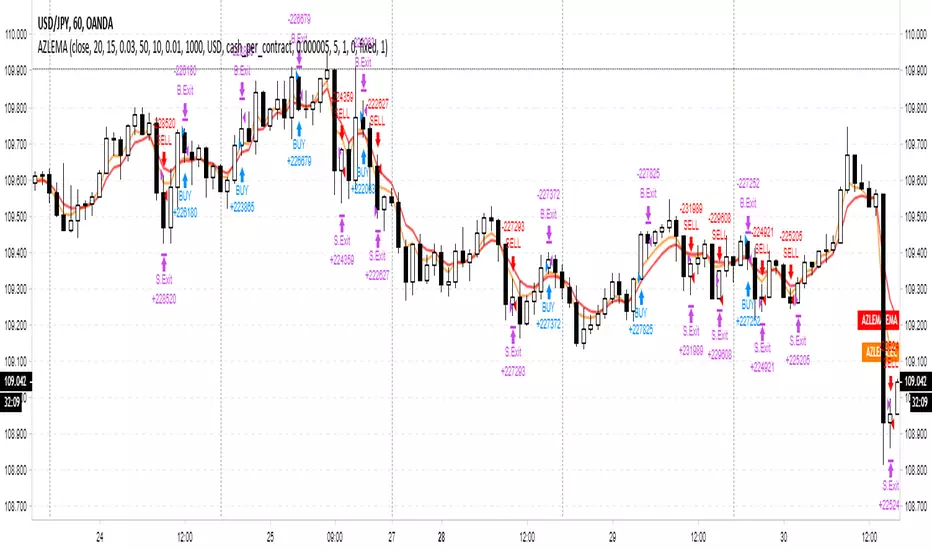
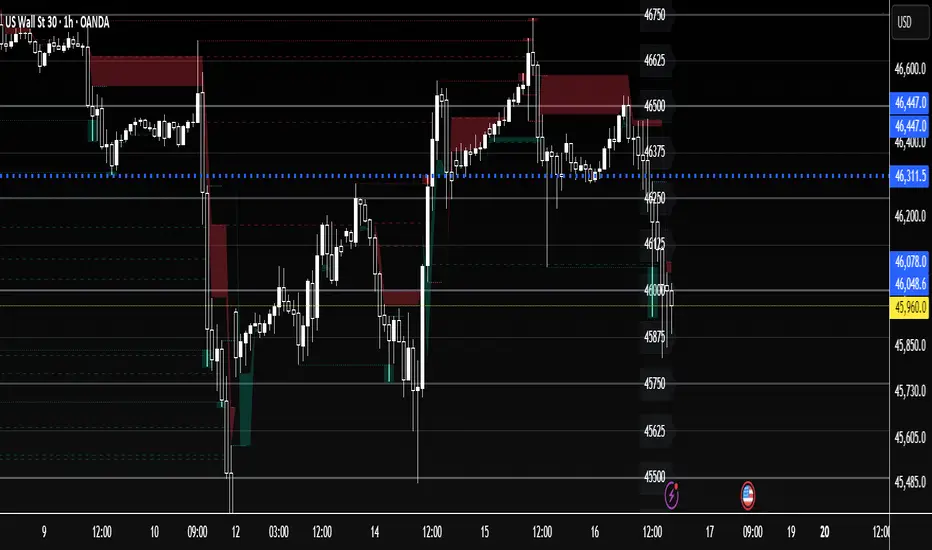
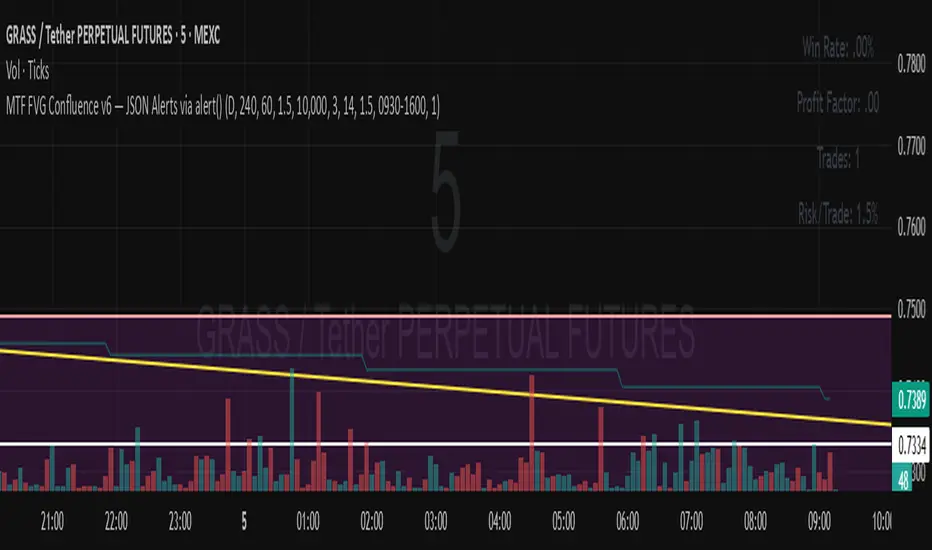
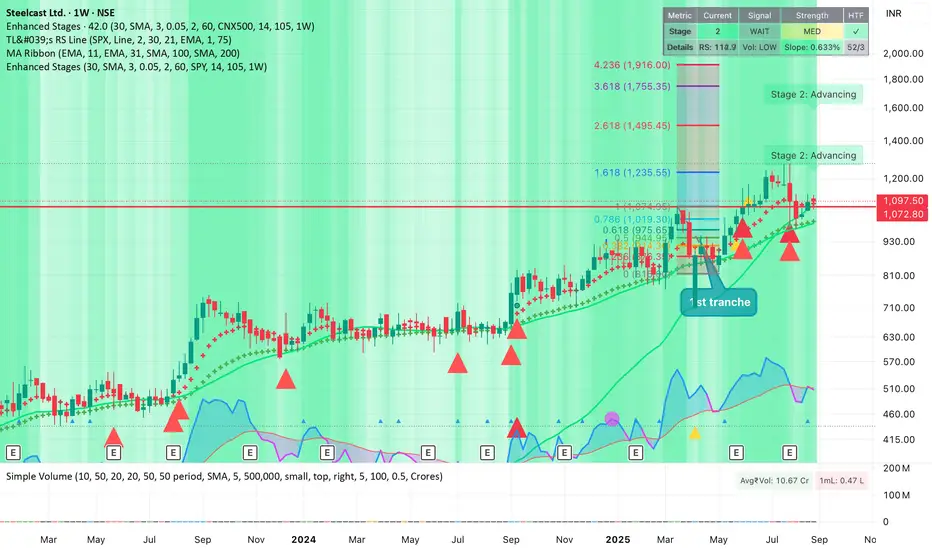
Breakout ProAdvanced breakout/breakdown indicator featuring multi-pattern detection, quality tier scoring (S/A/B/C), strength analysis (0-10), VWAP integration, multi-timeframe filters, and adaptive R-based take-profit/stop-loss framework. Includes comprehensive dashboard with real-time metrics and market regime detection.
Cerca negli script per "Cycle"
CK CloudOnly two moving averages that change color when they cross: blue for buy and yellow for sell, both configurable.
Previous Close Percentage LevelsInstitutional Previous Close Percentage Levels (Visual).
This indicator plots percentage-based levels calculated from the previous daily close, designed for clean intraday context and Replay analysis.
Features:
• Automatic daily recalculation
• Levels displayed only for the current trading day
• Clear 0% reference line (previous close) without label
• Configurable percentage steps (+ / −)
• Right-side percentage labels
• Visual TOUCH markers (price interaction)
• Visual BREAK markers (confirmed close beyond level)
• Replay-safe logic (no infinite lines)
• Pine Script v6 compatible
This script is focused on visual clarity and price context.
No audible or popup alerts are used — only on-chart visual signals.
Ideal for:
• Intraday bias
• Mean reversion
• Breakout confirmation
• Futures, Forex, Crypto, Stocks
10% Above 52-Week MidpointThis is a useful point for all my investors/ trader's friends. The point is referred to as the median point between the 52-week high and 52 weeks low. And here we say that we identify any underlying asset that is at 10% above the median. Very useful information.
VWAP Direction HelperVWAP Direction Helper – Oscillator Panel is a lightweight directional bias indicator designed for intraday traders and scalpers who want a clear market context without cluttering the price chart. The script automatically plots an anchored VWAP based on a user-defined session start time and displays a minimal two-row dashboard in a separate oscillator panel. The dashboard shows the VWAP status (Active or Not Active, including the anchor time) and the current price location relative to VWAP. When price is above VWAP, the location is highlighted in green to indicate bullish bias; when below VWAP, it is shown in purple to indicate bearish bias. The indicator does not generate buy or sell signals and does not repaint—its sole purpose is to act as a market compass, helping traders align their execution strategies with the dominant intraday direction.
Trend Warning / Direction (EMA20/50)Hier ist der Changelog-Text für die Veröffentlichung:
Update v1.1 – Optimized Signal Timing
Changes:
Warning triangles (yellow) now trigger in real-time for early detection of potential EMA crossovers
Crossover signals (green/red) now only confirm on candle close to prevent false signals
Removed confirmOnClose option as the optimal behavior is now built-in
Why this matters:
Get early warnings as soon as EMAs start converging – no waiting for candle close
Confirmed crossover signals won't repaint or disappear – what you see is final
Best of both worlds: speed for warnings, reliability for entries
Nth Candle movement🔷 Indicator Name
Nth candle movement – Nth Candle Projection & Dynamic EMA System
________________________________________
🔷 Short Description
Nth candle movement is an advanced price-based indicator that uses Nth candle mathematics, percentage projections, and a dynamic EMA system to visualize intraday structure and evolving market momentum.
________________________________________
🔷 Overview
Nth candle movement combines time-based Nth candle logic, percentage offset zones, and a stage-based dynamic EMA to help traders understand how price behaves around mathematically derived reference points.
Instead of using fixed indicators, this script dynamically adapts to:
• Day structure
• Time progression
• Price reaction around calculated levels
The indicator automatically resets every new trading day, ensuring fresh, non-repainting levels.
________________________________________
🔷 Core Concepts Used
• Nth candle calculation based on day of month
• Percentage-based expansion and contraction zones
• 0.2611% precision micro-levels
• Dynamic EMA length that evolves with time
• Angle-inspired mathematical projections
________________________________________
🔷 Key Features
🔹 Nth Candle Projection Systems (4 Systems)
• Four independent Nth systems based on angle mathematics
• Automatically captures the Nth candle close
• Projects:
o Upper & lower percentage zones
o Precision 0.2611% levels
• Daily auto-reset (no clutter)
Each system can be individually enabled or disabled.
________________________________________
🔹 Visual Zone Highlighting
• Upper and lower projection bands
• Color-filled zones for better clarity
• Clean object management (lines, labels, fills)
________________________________________
🔹 Nth Marker Labels
• Optional Nth candle markers
• Helps visually identify the exact calculation point
________________________________________
🔹 Dynamic EMA System (Angle-Based)
• EMA length dynamically changes as market progresses
• Uses multiple Nth stages to shift EMA behaviour
• Color-coded EMA reflects the active mathematical phase
This allows traders to see momentum transitions instead of guessing them.
________________________________________
🔷 How to Use
1. Apply the indicator on any intraday or higher timeframe
2. Observe Nth candle markers and projected zones
3. Watch how price reacts inside or outside the zones
4. Use the Dynamic EMA color and slope as momentum guidance
5. Combine with price action or confirmation logic for entries
⚠️ This is a decision-support tool, not a buy/sell signal generator.
This indicator is for educational and informational purposes only.
It does not constitute financial advice.
Trading involves risk, and past performance does not guarantee future results.
Always do your own analysis before entering any trade.
________________________________________
🔷 Best Use Cases
• Intraday structure analysis
• Volatility expansion tracking
• Time-based price reaction studies
• Momentum phase identification
________________________________________
🔷 Timeframe Compatibility
✅ Works on all timeframes
Best suited for:
• 3m, 5m, 15m (Intraday)
• 1H, 4H (Swing structure)
________________________________________
🔷 Asset Compatibility
✔ Stocks
✔ Indices
✔ Forex
✔ Crypto
✔ Futures
ICT Macros FuturesAll Macros Detected:
Early / Pre Market
- 02:33 – 03:10 (NY)
- 04:03 – 04:30
- 05:20 – 05:40
- 05:50 – 06:10
- 07:50 – 08:10
- 08:20 – 08:40
Cash Open / Morning
- 08:50 – 09:10
- 09:20 – 09:40
- 09:50 – 10:10
Midday / Lunch
- 10:50 – 11:10
- 11:50 – 12:10
- 12:00 – 13:30 (Lunch Hour)
Afternoon
- 13:10 – 13:40
- 14:20 – 14:40
- 15:15 – 15:45
- 15:50 – 16:10
QQQ 2025 Bucket ATR (Price & Volume)Work on QQQ, 1-minute timeframe.
Restrict to the year 2025
Breaks the Trading Day into buckets:
9:30–10:30
10:30–11:30
11:30–12:30
12:30–13:30
13:30–14:30
14:30–15:30
15:30–16:00
For each bucket, across all 2025 trading days, compute:
Price ATR-style movement (true range for that bucket)
“ATR” on bucket volume (day-to-day change in total bucket volume)
Average total volume per bucket
byquan RSI Divergence (OB/OS + RSI MA Base)byquan RSI Divergence (OB/OS + RSI MA Base)
Description
byquan RSI Divergence is a technical analysis indicator designed to visualize RSI-based divergence patterns within clearly defined overbought and oversold zones, enhanced with an optional RSI moving average baseline.
The script focuses on structural divergence detection rather than signal prediction, providing visual reference points to help users study momentum behavior and price–oscillator relationships.
This indicator is intended for educational and analytical purposes only.
Conceptual Overview
The core idea of this indicator is based on a widely accepted technical principle:
When price structure and momentum structure diverge, market behavior may be transitioning rather than continuing impulsively.
Instead of reacting to every fluctuation, this script identifies well-defined divergence formations that occur:
At RSI pivot points
Within controlled lookback ranges
Inside overbought or oversold zones
Indicator Components
1. RSI Oscillator
The indicator uses a standard Relative Strength Index (RSI):
User-defined period
User-defined source price
RSI values are plotted directly in the pane for transparency and clarity.
2. RSI Base Moving Average
An optional RSI baseline is calculated using a selectable moving average type:
SMA
EMA
RMA
WMA
This baseline is intended to provide additional context for momentum direction and smoothing, not as a signal trigger.
3. Overbought / Oversold Zones
Customizable horizontal levels define:
Overbought conditions
Oversold conditions
Divergences are evaluated only when RSI is located inside the corresponding zone, helping reduce irrelevant signals.
4. Pivot-Based Divergence Detection
The script detects RSI pivot highs and lows using configurable left/right lookback values.
Based on these pivots, it evaluates four divergence types:
Regular Bullish Divergence
Hidden Bullish Divergence
Regular Bearish Divergence
Hidden Bearish Divergence
Each divergence type is plotted independently and can be enabled or disabled by the user.
5. Lookback Range Control
To avoid excessive or outdated comparisons, divergence evaluation is constrained within a user-defined bar range.
This helps ensure that only structurally relevant divergences are displayed.
Visualization
Divergence lines are plotted directly on the RSI pane
Labels are used to distinguish divergence types
Regular and hidden divergences are visually differentiated using color transparency
The indicator prioritizes clarity and interpretability over signal density.
Alert Logic
An alert condition is provided when any divergence type is detected.
Alerts are informational and do not imply direction, timing, or outcome.
Intended Use
This indicator is designed to be used as:
A momentum structure study tool
A visual divergence reference
A supporting component within broader technical analysis
It is not intended to:
Predict market tops or bottoms
Serve as a standalone trading system
Provide financial or investment advice
Technical Notes
The script uses pivot-based confirmation and therefore does not repaint
All calculations are deterministic and rule-based
Divergences are identified only after pivots are confirmed
Results may vary across assets and timeframes
Attribution & Transparency
This script represents a custom implementation and adaptation of commonly documented RSI divergence techniques, including:
Pivot-based divergence logic
Overbought / oversold filtering
RSI smoothing via moving averages
These concepts are widely used in technical analysis.
The specific parameterization, visualization, and filtering structure reflect a personal analytical approach, without claiming exclusivity over the underlying methods.
Disclaimer
This indicator is provided for educational and analytical purposes only.
It does not constitute financial advice, trading recommendations, or performance guarantees.
Past behavior does not imply future results.
GLI Regime Index (v1.0)GLI Regime Index
Global Liquidity Intelligence for Risk Markets
The GLI Regime Index is a macro-liquidity regime engine that classifies the financial system based on where cash is actually flowing inside the Fed–Treasury plumbing.
Markets do not move on narratives.
They move on liquidity.
GLI measures that liquidity in real time by combining four institutional-grade signals:
• Fed Reverse Repo (RRP) – where excess cash is being parked
• 3-Month Treasury Bills – where short-term money prefers to earn yield
• IORB – the Federal Reserve’s policy floor
• SOFR – the true cost of funding in the system
By comparing these flows, GLI identifies which institution is currently in control of money:
Regime What It Means
FED DOMINANT Abundant reserves, liquidity flowing into risk assets
T-BILL DOMINANT Treasury absorbing liquidity, risk tightening
CASH GLUT Excess money trapped at the Fed (RRP high)
FUNDING STRESS Funding markets under pressure (SOFR > IORB)
NEUTRAL Transition state between regimes
These regimes are not opinions — they are the mechanical state of the dollar system.
Why this matters
Assets like NVDA, BTC, high-beta tech, and growth stocks don’t trade on earnings — they trade on marginal liquidity.
GLI tells you:
When rallies are supported by real money
When breakouts are likely to fail
When dips are being bought vs distributed
When risk is being quietly withdrawn
If you’ve ever wondered why price seems to hit invisible walls,
GLI shows you where those walls come from.
How to use it
Apply GLI to any chart.
When the background turns:
Green (Fed Dominant) → Risk assets are structurally supported
Orange (T-Bill Dominant) → Liquidity is draining from risk
Blue (Cash Glut) → Money is stuck at the Fed, rallies struggle
Red (Funding Stress) → Volatility and liquidation risk rise
The built-in Liquidity HUD shows:
RRP usage
Fed vs Treasury dominance
SOFR stress
Rate spreads in real time
No interpretation required.
What GLI is not
GLI is not a technical indicator.
It does not look at price, volume, or momentum.
It looks at the money behind the price.
That’s why it works.
Vertical line at 6PMVertical line deliniated every 6pm for the asian session trading and backtesting.
Gold Chop MeterWhat it does
It’s a market quality filter. It does NOT tell you direction.
It tells you when Gold is too compressed/choppy to trust clean expansions.
NORMAL = tradable conditions
CHOP = compressed / messy conditions
NO TRADE (30M BOX) = hard stop (30M is CHOP)
NO TRADE (HTF CHOP) = hard stop (majority of higher TFs are CHOP)
How to read the panel (left → right)
You’ll see:
1H: NORMAL/CHOP | 30M: NORMAL/CHOP | 15M: NORMAL/CHOP | 5M: NORMAL/CHOP | TRADE/NO TRADE
The rules (exact)
If 30M = CHOP → NO TRADE (30M BOX)
This is your strongest filter. Don’t fight it.
If 30M isn’t CHOP, then it checks majority:
Default: 1H + 30M + 15M
If 2 of 3 are CHOP → NO TRADE (HTF CHOP)
If those are not true → it prints TRADE
If 15M is CHOP but 30M is NORMAL, it prints:
“TRADE (CAUTION – 15M CHOP)”
That means: trade smaller, quicker, or wait for cleaner trigger.
Settings you actually need to touch
1) Profile
Auto (by session) = best for most days (it changes the threshold by time window)
NYO / Overnight / London profiles are there if you want to force one behavior.
2) ATR Length (fixed)
Default 4 is good for Gold.
If it’s too sensitive (flips CHOP too often), raise to 5.
If it’s too slow (stays NORMAL when price is dead), drop to 3.
3) Include 5M in majority filter? (default OFF)
OFF = cleaner, less restrictive (recommended)
ON = stricter filter (needs 3 of 4 to be CHOP for “HTF CHOP” but 5M influences the count)
How to use it with your purge strategy (simple playbook)
When it says TRADE
You’re allowed to execute your normal model:
Sweep → displacement / CHoCH → first return → run
When it says TRADE (CAUTION – 15M CHOP)
Still tradable, but:
take A+ only
smaller size
quicker TP, don’t expect runners
demand a cleaner trigger (strong displacement)
When it says NO TRADE
You don’t force entries.
What you do instead:
wait for 30M to flip back to NORMAL
or wait for a clear range break + retest that turns the environment back to expansion
Quick “decision cheat”
30M CHOP? → Stop. No trade.
2/3 HTFs CHOP? → Stop. No trade.
Only 15M CHOP? → Trade, but cautious.
All NORMAL? → Green light.
Estrategia Timing SMA 10 de Faber Introduction This strategy is based on the classic trend-following logic popularized by Meb Faber in his white papers (such as "A Quantitative Approach to Tactical Asset Allocation") and frequently discussed by financial analyst José Luis Cárpatos. The core philosophy is simple but effective: stay in the market during uptrends to capture growth, and move to cash during downtrends to protect capital from major drawdowns.
This is a long-term "Timing" strategy designed for investors who want to filter out market noise and focus on the primary macro trend.
How it Works The strategy utilizes a specific Moving Average on a Monthly timeframe to determine the trend direction.
The Indicator: A 10-period Simple Moving Average (SMA) calculated on the Monthly timeframe (1M).
Long Condition: When the Monthly Close price is above the 10-Month SMA, the strategy enters a Long position (Risk On).
Exit Condition (Cash): When the Monthly Close price falls below the 10-Month SMA, the strategy closes the position and stays in Cash (Risk Off). It does not open short positions; it simply exits the market to preserve capital.
Key Features (Multi-Timeframe) This script has been coded using request.security to force the calculation on Monthly data (1M), regardless of the chart timeframe you are currently viewing.
This allows you to view the strategy on a Daily or Weekly chart while ensuring the mathematical logic remains strictly bound to the Monthly moving average.
The SMA line will appear "stepped" on lower timeframes (e.g., Daily), representing the constant value of the SMA for that specific month.
Settings
Length: Default is 10 (representing 10 Months), but this can be adjusted if you wish to test other periods (e.g., 12 months).
Source: Defaults to close.
Visuals
Blue Line: Represents the 10-Month SMA.
Background Color:
Green: Indicates the strategy is currently Long (Price > SMA).
Red/Grey: Indicates the strategy is in Cash (Price < SMA).
Important Note on Backtesting & Repainting Because this strategy requests Monthly data on lower timeframes (like Daily), please be aware that the current month's data is dynamic. The signal is technically confirmed only at the close of the monthly bar. When viewing on a Daily chart, the script evaluates the relationship between the current price and the current monthly SMA.
Disclaimer This script is for educational and research purposes only. Past performance is not indicative of future results. Always manage your risk appropriately.
SLS CAPITALThe idea behind this indicator is to mark the high and low of each section, looking, for example, for a theme of confluence between days in order to find days that converge with a thesis of the strategy we have.
Sector Rotation ULTIMATE: 7 Narrativas IndependientesSector Rotation ULTIMATE: Crypto Narrative Rotation (7 Independent Sectors)
Advanced indicator displaying the relative strength of major crypto sectors through 7 independently normalized lines (0-100):
• Layer1 (ETH, SOL, BNB, TON, etc.) - Pink
• Enterprise (XRP, HBAR, XLM, QNT, VET) - Yellow
• DeFi (UNI, AAVE, MKR, LDO, CRV, etc.) - Cyan
• Memecoins (SHIB, DOGE, PEPE, WIF, FLOKI, BONK) - Green
• AI (TAO, FET, ICP, GRT, etc.) - Orange
• L2 / Scalability (ARB, OP, MATIC, STRK) - Purple
• RWA + Infra (ONDO, LINK) - Brown
Each sector sums the dominance of its top coins (40 total) and is normalized independently so the lines cross constantly, revealing real capital rotations.
- Colored fills to visually highlight the leading sector
- Works perfectly on any timeframe (clean daily data, no intraday noise)
- Ideal for spotting altseason, sector rotations, and entry timing
Use on CRYPTOCAP:TOTAL. The definitive narrative oscillator for 2026!
#Crypto #Altcoins #SectorRotation #DeFi #Memecoins #AI #RWA
50SMA bounceScans stocks that closed above Weekly 10SMA and previous week closing below the weekly 10SMA
MACDTraditional MACD
Used in Kinetic Momentum Theory
The histogram is 2 times higher than the Tradingview default MACD