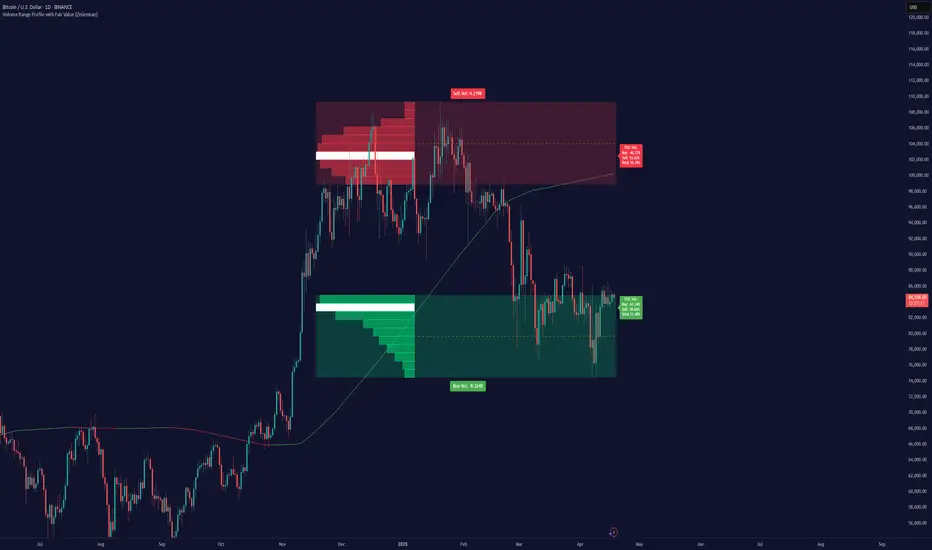
Volume Anchored Price Map [LuxAlgo]The Volume Anchored Price Map indicator is a sophisticated institutional-grade tool designed to visualize where the highest concentration of trading activity is occurring relative to current price action.
By combining statistical volume analysis through dynamic "Bubbles" with a retrospective Volume Profile, it allows traders to identify high-interest liquidity zones and potential institutional support/resistance levels.
🔶 USAGE
The indicator provides a multi-layered view of market activity, helping traders distinguish between standard price movement and high-conviction institutional participation.
🔹 Identifying Institutional S/R
The projected dashed lines with TIER labels act as a roadmap for liquidity. Institutions often defend positions at these high-volume price points. When price returns to a TIER I level, traders should expect a significant reaction, either in the form of a strong reversal or a high-momentum breakout.
🔹 Spotting Absorption and Exhaustion
Large bubbles often signal the end of a move or the beginning of a major shift:
Exhaustion : Large red bubbles at the end of a downtrend suggest sellers are throwing in the towel (climax).
Absorption : Large green bubbles at the top of an uptrend can indicate institutional absorption of supply or a "blow-off" top.
🔹 Market Speed and the Value Area
The Price Map profile reveals the "thickness" of the market at specific prices:
High Volume Nodes (Wide/Bright Bars) : Expect price to slow down and consolidate. These are "sticky" areas where the market is comfortable.
Low Volume Areas (Thin Bars) : Price often moves through these zones rapidly due to a lack of historical interest, facilitating fast breakouts.
🔶 HOW TO USE
Traders can utilize the Volume Anchored Price Map to identify high-probability entries based on where "smart money" has previously transacted.
Filter Price Action : Look for TIER I or TIER II levels that align with the widest bars (High Volume Nodes) of the Price Map Profile. These confluences mark the strongest historical "Fair Value" zones.
Wait for Mean Reversion : If price deviates far from the High Volume Nodes into a "Low Volume Area" and a large Volume Bubble appears, it often indicates an exhaustion point where price is likely to snap back toward the high-volume center.
Breakout Confirmation : Use the levels as a breakout filter. A candle closing decisively above or below a projected TIER level—accompanied by a new Volume Bubble—suggests institutional participation in the new direction.
🔶 DETAILS
🔹 Price Map (The Gradient Histogram)
The tool looks back at a user-defined lookback window and calculates the total volume traded at every price bin. It displays this as a heatmap anchored to the right. Brighter, wider bars represent High Volume Nodes (HVN) where the market has found significant value or spent considerable time.
🔹 Volume Bubbles (Z-Score Analysis)
Instead of using raw volume, the script utilizes a Z-Score (a statistical measure of standard deviations from the mean). When volume spikes significantly above the average, a bubble is placed on the price action. The bubble size scales dynamically based on its statistical intensity (Z-Score), ranging from "Tiny" to "Huge."
🔹 Projected Anchor Levels
When a significant volume bubble is detected, the script "anchors" that price level and projects it forward. These levels are categorized by importance:
TIER I (Extreme) : Massive liquidity events (> 6 standard deviations). Major structural significance.
TIER II (High) : Strong institutional interest (4 to 6 standard deviations).
TIER III (Significant) : Noteworthy volume spikes (2 to 4 standard deviations).
🔶 SETTINGS
🔹 Price Map Profile
Lookback Length : Determines the historical window used to calculate the volume profile and identify bubbles.
Price Bins : The vertical resolution of the profile. Higher values create a more detailed histogram.
Show Price Map Profile : Toggles the visibility of the volume heatmap.
Profile Color : Sets the base color for the volume profile gradient.
🔹 Volume Bubbles
Show Volume Bubbles : Toggles the visibility of the Z-Score based circles.
Bubble Sensitivity (Z-Score) : The threshold at which a volume spike is considered significant enough to display.
Project Levels from Bubbles : Enables the projection of horizontal dashed lines from significant bubbles.
Max Projected Levels : Limits the number of active anchor levels displayed on the chart.
Label Horizontal Offset : Adjusts the position of the TIER labels to prevent overlap with the profile.
🔹 Dashboard
Enable Dashboard : Toggles the data table showing lookback, POC (Max Vol Level), and current Z-Score.
Position/Size : Controls the visual placement and scale of the dashboard on the chart.
Indicatore Pine Script®