
Description
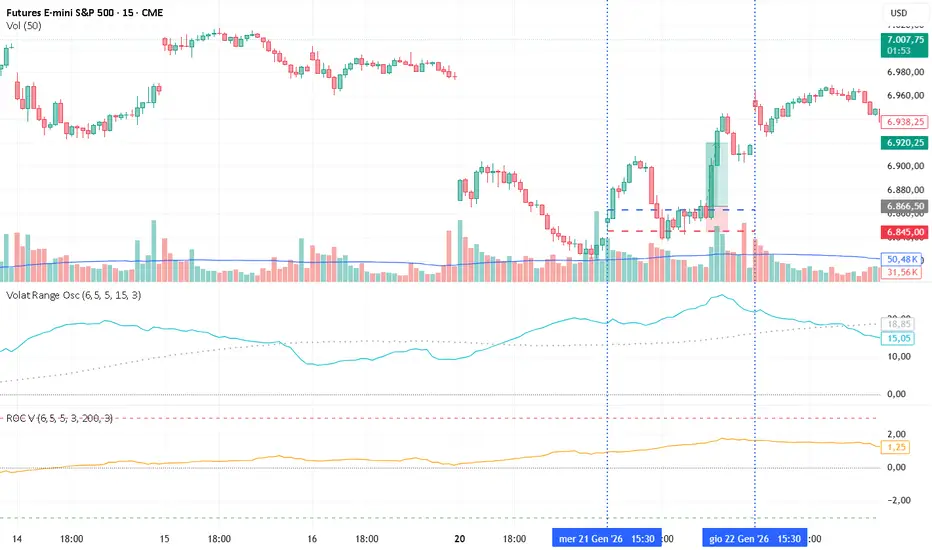
This Idea presents a clean intraday breakout setup on the S&P 500 (SPX / ES / SPY), based on the classic Opening Range Breakout (ORB) concept.
Core Setup (visible on chart)
Opening Range (OR): Defined by the high and low of the first 15-minute bar after NYSE open (8:30–8:45 ET).
→ Blue stepped line = OR High
→ Red stepped line = OR Low
Bullish trigger: Price closes above OR High → potential long breakout
Bearish trigger: Price closes below OR Low → potential short breakdown
Why this works
Early-session breakouts often capture institutional momentum right after the open, especially on high-volume, expanding-range days.
Filter for expansive volatility (custom oscillator: fast 5-day SMA vs slow 15-day SMA of true range, requiring crossover or >0 condition).
Volume confirmation: Smoothed ROC of session volume must be positive (indicating building participation).
Risk control: Only consider setups where the implied Reward:Risk (target = OR range × 2.0) is at least 1.5:1 after filters.
No late-day traps: strictly avoid entries after 14:00 ET (last hour of regular session) to dodge choppy, low-conviction afternoon moves.
Trade Parameters (example for current/last chart)
- Direction bias: [Bullish / Bearish / Neutral – update based on your chart]
- Entry: Break & close beyond OR high/low
- Target: OR range × 2.5 from entry (e.g., if OR = 20 points, target +40 points on long)
- Stop: Opposite side of OR (tight risk)
- Timeframe: 15-min intraday
Max 1 trade per day; forced exit at session close (15:00–16:00 ET) if not already hit.
This is a high-conviction intraday framework I've been refining — good for capturing intraday moves while filtering noise.
What do you think — would you take this setup today? Drop your thoughts below!
This Idea presents a clean intraday breakout setup on the S&P 500 (SPX / ES / SPY), based on the classic Opening Range Breakout (ORB) concept.
Core Setup (visible on chart)
Opening Range (OR): Defined by the high and low of the first 15-minute bar after NYSE open (8:30–8:45 ET).
→ Blue stepped line = OR High
→ Red stepped line = OR Low
Bullish trigger: Price closes above OR High → potential long breakout
Bearish trigger: Price closes below OR Low → potential short breakdown
Why this works
Early-session breakouts often capture institutional momentum right after the open, especially on high-volume, expanding-range days.
Filter for expansive volatility (custom oscillator: fast 5-day SMA vs slow 15-day SMA of true range, requiring crossover or >0 condition).
Volume confirmation: Smoothed ROC of session volume must be positive (indicating building participation).
Risk control: Only consider setups where the implied Reward:Risk (target = OR range × 2.0) is at least 1.5:1 after filters.
No late-day traps: strictly avoid entries after 14:00 ET (last hour of regular session) to dodge choppy, low-conviction afternoon moves.
Trade Parameters (example for current/last chart)
- Direction bias: [Bullish / Bearish / Neutral – update based on your chart]
- Entry: Break & close beyond OR high/low
- Target: OR range × 2.5 from entry (e.g., if OR = 20 points, target +40 points on long)
- Stop: Opposite side of OR (tight risk)
- Timeframe: 15-min intraday
Max 1 trade per day; forced exit at session close (15:00–16:00 ET) if not already hit.
This is a high-conviction intraday framework I've been refining — good for capturing intraday moves while filtering noise.
What do you think — would you take this setup today? Drop your thoughts below!

Declinazione di responsabilità
Le informazioni e le pubblicazioni non sono intese come, e non costituiscono, consulenza o raccomandazioni finanziarie, di investimento, di trading o di altro tipo fornite o approvate da TradingView. Per ulteriori informazioni, consultare i Termini di utilizzo.
Declinazione di responsabilità
Le informazioni e le pubblicazioni non sono intese come, e non costituiscono, consulenza o raccomandazioni finanziarie, di investimento, di trading o di altro tipo fornite o approvate da TradingView. Per ulteriori informazioni, consultare i Termini di utilizzo.