
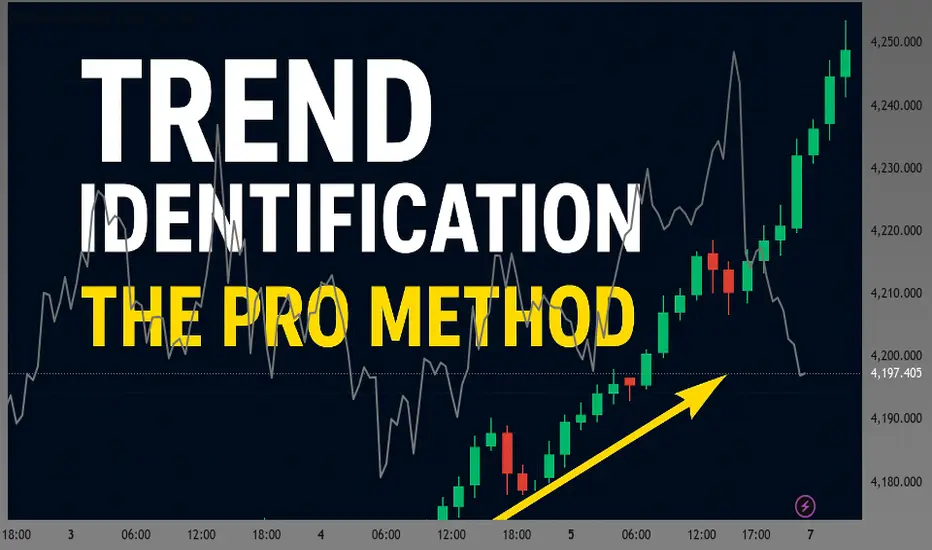
The Foundation of Every Winning Trading Strategy
Identifying the trend is the most important skill a trader can develop. Almost every successful strategy — breakouts, pullbacks, SMC, swing trading, scalping — depends on knowing whether the market is trending or ranging. In this educational idea, you’ll learn how professionals detect the trend using clean, simple price-action rules that work on every timeframe and every market.
---
🔹 Why Trend Identification Matters
Most losing trades happen because traders enter against the trend.
A strong bullish or bearish trend makes:
- Breakouts more reliable
- Pullbacks cleaner
- Targets larger
- Reversals less frequent
When you follow the trend, your trades have a natural advantage.
---
🔹 Step 1: Understand Market Structure (HH, HL, LH, LL)
The trend is defined by swing structure, not indicators.
Bullish Trend Structure
- Higher High (HH)
- Higher Low (HL)
- New Higher High (HH)
This shows buyers are in control.
Bearish Trend Structure
- Lower Low (LL)
- Lower High (LH)
- New Lower Low (LL)
This shows sellers dominate.
If structure is unclear, the market is likely ranging, not trending.
---
🔹 Step 2: Use the “Three-Push Rule”
A simple rule:
If you see three consecutive HH + HL, the trend is confirmed bullish.
If you see three consecutive LL + LH, the trend is confirmed bearish.
This rule filters out fake short-term moves.
---
🔹 Step 3: Identify Trend Strength Using Candle Behavior
Trend strength shows in the candles:
Strong Bullish Trend Candles
- Large green bodies
- Small or no lower wicks
- Fast recovery after pullbacks
Strong Bearish Trend Candles
- Large red bodies
- Small or no upper wicks
- Sharp drops after minor retracements
Candle behavior tells you confidence and momentum.
---
🔹 Step 4: Check Pullbacks for Confirmation
Pullbacks are the heart of trend trading.
Bullish Pullback Confirmation
- Slow downward correction
- Decreasing candle size
- Tap into demand or previous structure
- Powerful bullish continuation candle
Bearish Pullback Confirmation
- Slow upward correction
- Weak bullish candles
- Tap into supply zone
- Strong bearish continuation candle
The nature of pullbacks reveals trend quality.
---
🔹 Step 5: Use Dynamic Support & Resistance (Trendlines)
Trendlines help visualize the trend direction:
- Uptrend → connect lows
- Downtrend → connect highs
If price respects the trendline multiple times, the trend is strong.
But remember:
Trendlines support your analysis, they don’t replace market structure.
---
🔹 Step 6: Multi-Timeframe Trend Alignment (MTF)
Professional traders follow the higher timeframe trend.
Example for Gold (XAUUSD):
- Daily trend: Bullish
- 4H trend: Bullish
- 1H trend: Bullish
Now you take only buys on 15m or 5m.
This increases accuracy dramatically.
If higher timeframes disagree, expect:
- Choppiness
- Ranges
- Unknown direction
MTF alignment = cleaner trades.
---
🔹 Step 7: Spot Trend Reversals Early
Reversals happen after clear signals:
Bullish → Bearish Reversal
- Failure to create new HH
- Break of previous HL (structure break)
- Formation of LH
- Shift of order flow
Bearish → Bullish Reversal
- Failure to create new LL
- Break of previous LH
- Formation of HL
- Bullish BOS (Break of Structure)
Structure tells you when the trend has officially changed.
---
🔥 Final Professional Tip
Do not fight the trend.
A trend can stay strong longer than traders expect.
Use:
- Structure
- Pullbacks
- Trendlines
- Multi-timeframe alignment
- Momentum candles
Combine these methods and you’ll identify trends with clarity and confidence — just like professional traders.
Your boosts, comments, and likes motivate me to share more accurate analyses like this.
👉 If you found this helpful, please Boost the idea and leave a comment — it really helps!
— JT_CHARTsMaster
Identifying the trend is the most important skill a trader can develop. Almost every successful strategy — breakouts, pullbacks, SMC, swing trading, scalping — depends on knowing whether the market is trending or ranging. In this educational idea, you’ll learn how professionals detect the trend using clean, simple price-action rules that work on every timeframe and every market.
---
🔹 Why Trend Identification Matters
Most losing trades happen because traders enter against the trend.
A strong bullish or bearish trend makes:
- Breakouts more reliable
- Pullbacks cleaner
- Targets larger
- Reversals less frequent
When you follow the trend, your trades have a natural advantage.
---
🔹 Step 1: Understand Market Structure (HH, HL, LH, LL)
The trend is defined by swing structure, not indicators.
Bullish Trend Structure
- Higher High (HH)
- Higher Low (HL)
- New Higher High (HH)
This shows buyers are in control.
Bearish Trend Structure
- Lower Low (LL)
- Lower High (LH)
- New Lower Low (LL)
This shows sellers dominate.
If structure is unclear, the market is likely ranging, not trending.
---
🔹 Step 2: Use the “Three-Push Rule”
A simple rule:
If you see three consecutive HH + HL, the trend is confirmed bullish.
If you see three consecutive LL + LH, the trend is confirmed bearish.
This rule filters out fake short-term moves.
---
🔹 Step 3: Identify Trend Strength Using Candle Behavior
Trend strength shows in the candles:
Strong Bullish Trend Candles
- Large green bodies
- Small or no lower wicks
- Fast recovery after pullbacks
Strong Bearish Trend Candles
- Large red bodies
- Small or no upper wicks
- Sharp drops after minor retracements
Candle behavior tells you confidence and momentum.
---
🔹 Step 4: Check Pullbacks for Confirmation
Pullbacks are the heart of trend trading.
Bullish Pullback Confirmation
- Slow downward correction
- Decreasing candle size
- Tap into demand or previous structure
- Powerful bullish continuation candle
Bearish Pullback Confirmation
- Slow upward correction
- Weak bullish candles
- Tap into supply zone
- Strong bearish continuation candle
The nature of pullbacks reveals trend quality.
---
🔹 Step 5: Use Dynamic Support & Resistance (Trendlines)
Trendlines help visualize the trend direction:
- Uptrend → connect lows
- Downtrend → connect highs
If price respects the trendline multiple times, the trend is strong.
But remember:
Trendlines support your analysis, they don’t replace market structure.
---
🔹 Step 6: Multi-Timeframe Trend Alignment (MTF)
Professional traders follow the higher timeframe trend.
Example for Gold (XAUUSD):
- Daily trend: Bullish
- 4H trend: Bullish
- 1H trend: Bullish
Now you take only buys on 15m or 5m.
This increases accuracy dramatically.
If higher timeframes disagree, expect:
- Choppiness
- Ranges
- Unknown direction
MTF alignment = cleaner trades.
---
🔹 Step 7: Spot Trend Reversals Early
Reversals happen after clear signals:
Bullish → Bearish Reversal
- Failure to create new HH
- Break of previous HL (structure break)
- Formation of LH
- Shift of order flow
Bearish → Bullish Reversal
- Failure to create new LL
- Break of previous LH
- Formation of HL
- Bullish BOS (Break of Structure)
Structure tells you when the trend has officially changed.
---
🔥 Final Professional Tip
Do not fight the trend.
A trend can stay strong longer than traders expect.
Use:
- Structure
- Pullbacks
- Trendlines
- Multi-timeframe alignment
- Momentum candles
Combine these methods and you’ll identify trends with clarity and confidence — just like professional traders.
Your boosts, comments, and likes motivate me to share more accurate analyses like this.
👉 If you found this helpful, please Boost the idea and leave a comment — it really helps!
— JT_CHARTsMaster

→ Accurate Gold Setups
→ Market Structure | SMCs | Trend & Breakout Analysis
→ Join My Channel 👇
t.me/+MqtqMxC9fe02OTJk
→ For Support 👇
t.me/LegendaryZayan
→ Recommended Broker 👇
vigco.co/la-com/D6QxKb1s
→ Market Structure | SMCs | Trend & Breakout Analysis
→ Join My Channel 👇
t.me/+MqtqMxC9fe02OTJk
→ For Support 👇
t.me/LegendaryZayan
→ Recommended Broker 👇
vigco.co/la-com/D6QxKb1s
Pubblicazioni correlate
Declinazione di responsabilità
Le informazioni e le pubblicazioni non sono intese come, e non costituiscono, consulenza o raccomandazioni finanziarie, di investimento, di trading o di altro tipo fornite o approvate da TradingView. Per ulteriori informazioni, consultare i Termini di utilizzo.
→ Accurate Gold Setups
→ Market Structure | SMCs | Trend & Breakout Analysis
→ Join My Channel 👇
t.me/+MqtqMxC9fe02OTJk
→ For Support 👇
t.me/LegendaryZayan
→ Recommended Broker 👇
vigco.co/la-com/D6QxKb1s
→ Market Structure | SMCs | Trend & Breakout Analysis
→ Join My Channel 👇
t.me/+MqtqMxC9fe02OTJk
→ For Support 👇
t.me/LegendaryZayan
→ Recommended Broker 👇
vigco.co/la-com/D6QxKb1s
Pubblicazioni correlate
Declinazione di responsabilità
Le informazioni e le pubblicazioni non sono intese come, e non costituiscono, consulenza o raccomandazioni finanziarie, di investimento, di trading o di altro tipo fornite o approvate da TradingView. Per ulteriori informazioni, consultare i Termini di utilizzo.