
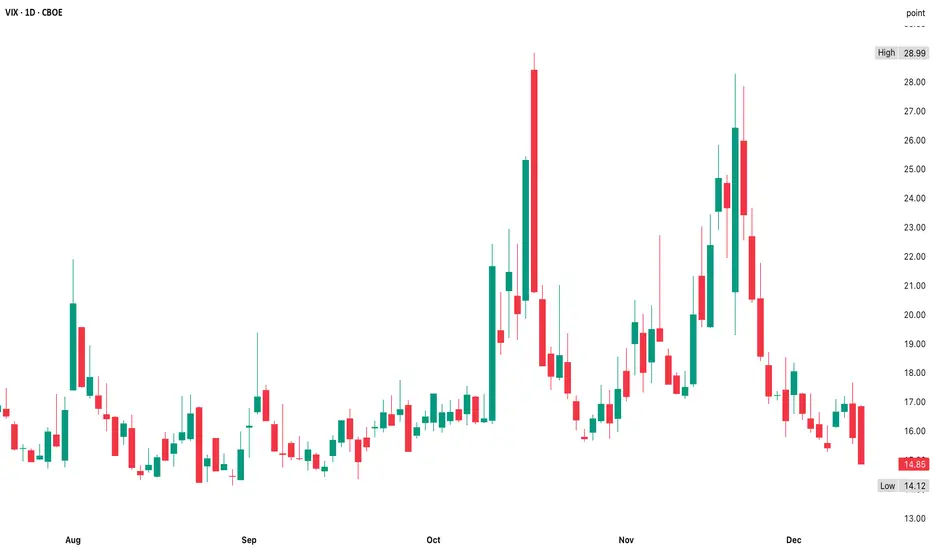
When the VIX is sitting around 15, it usually signals a low-volatility, risk-on environment, but with some nuances that traders often forget
1. Options market is pricing in calm conditions
2. Traders are not hedging aggressively
3. Markets may be vulnerable to shocks
4. For directional traders
A VIX ~15 during a macro-calm period normally means the market believes no near-term recession risk, earnings risk contained & the Fed's path relatively stable, but it also means any surprise (Fed tone shift, earnings miss, geopolitical flare) can cause outsized reactions, because positioning is light on hedges
When the VIX is this low, QQQ tends to operate in a low-volatility, mean-reversion–biased regime unless a catalyst disrupts it
1. Even though VIX is for the S&P, QQQ’s volatility correlates closely
2. Dips bought quickly
3. QQQ in low VIX mean uptrends extend slowly, downtrends fail faster unless news hits & breakdowns on the 1H/4H need volume + macro fear to stick
4. Calls inflate less, puts deflate hard
5. QQQ tends to outperform SPX when VIX is below 17
If you’re looking for a sharp 2-3% drop, you need a catalyst
Multiple retests of resistance without fear in the market typically favor eventual breakout, not breakdown, but the grind can be agonizing & fake-breakouts are common intraday
 QQQ
QQQ  SPY
SPY
1. Options market is pricing in calm conditions
- A VIX of 15 corresponds to ~15% implied volatility for S&P 500 options over the next 30 days
- Historically, 15 is below the long-term average (~19–20)
- Markets are expecting small daily moves
2. Traders are not hedging aggressively
- Demand for downside protection tends to be low
- Put/call skew typically flattens when the VIX is low
3. Markets may be vulnerable to shocks
- Low VIX ≠ “safe"
- It means complacency
- Historically, very low VIX often precedes sharp, but short volatility spikes, but it's not a timing tool - it can stay low for months during strong uptrends
4. For directional traders
- A VIX around 15 generally lines up with small intraday follow-through on breaks (low expansion), higher chance of grindy price action & harder to get big downside moves unless a catalyst hits, since vol sellers dominate
A VIX ~15 during a macro-calm period normally means the market believes no near-term recession risk, earnings risk contained & the Fed's path relatively stable, but it also means any surprise (Fed tone shift, earnings miss, geopolitical flare) can cause outsized reactions, because positioning is light on hedges
- Low-volatility regimes tend to support grinding rallies
- Dip-buying often shows up quickly
- VIX ~15 says pullbacks are likely to be shallow unless triggered by news
- 1.5-3% dips, but they are usually fast & bought
10-13 Extreme calm, often complacency
14-17 Mild calm, typical bullish grind
18-22 Normal volatility, healthy corrections
23+ Stress, hedging, risk-off
30+ Panic
When the VIX is this low, QQQ tends to operate in a low-volatility, mean-reversion–biased regime unless a catalyst disrupts it
1. Even though VIX is for the S&P, QQQ’s volatility correlates closely
- Typical QQQ daily range in a VIX 15 regime is ~0.9%–1.3%
- This makes big impulse moves harder, both up & down
- Breakouts can look significant on low timeframes, but fail more often because volatility expansion is muted
- This is why you're observing weak follow-through on selloffs
2. Dips bought quickly
- In a low-VIX backdrop, institutions run lighter hedges, buy dips mechanically & rebalance toward tech/mega-cap growth (which dominates QQQ)
- ITypical pullback depth during VIX 14-16 periods are commonly between 1-2.5%, 3-5% dips require a catalyst (earnings, Fed tone shift) - pure technicals rarely generate that move alone
3. QQQ in low VIX mean uptrends extend slowly, downtrends fail faster unless news hits & breakdowns on the 1H/4H need volume + macro fear to stick
- The environment doesn't support large downside legs unless something shocks implied vol
4. Calls inflate less, puts deflate hard
- Puts decay brutally
- IV is suppressed → premium is thin → directional bets need fast movement
- If price doesn’t follow through within 24-48 hours, puts lose value even if you’re still near your entry
- Calls don’t explode unless we get vol expansion
- Up moves in low VIX are grindy, not impulsive
- So calls rarely give outsized returns unless QQQ surges 1-2% in a day
- This is why positioning both ways right now feels “sticky” - price isn’t moving enough to reward options
5. QQQ tends to outperform SPX when VIX is below 17
- Low VIX = risk-on
- Risk-on = mega-cap + tech flows
- Mega-cap + tech flows = QQQ leadership
- So even in choppy conditions, QQQ often has a drift upward
If you’re looking for a sharp 2-3% drop, you need a catalyst
- AVGO earnings, a Fed comment, or some macro surprise
- A slow grind toward $630-$640 is what a VIX 15 regime naturally supports
Multiple retests of resistance without fear in the market typically favor eventual breakout, not breakdown, but the grind can be agonizing & fake-breakouts are common intraday
QQQ SPY
I am not a licensed professional & these posts are for informational purposes only, not financial advice.
Declinazione di responsabilità
Le informazioni e le pubblicazioni non sono intese come, e non costituiscono, consulenza o raccomandazioni finanziarie, di investimento, di trading o di altro tipo fornite o approvate da TradingView. Per ulteriori informazioni, consultare i Termini di utilizzo.
I am not a licensed professional & these posts are for informational purposes only, not financial advice.
Declinazione di responsabilità
Le informazioni e le pubblicazioni non sono intese come, e non costituiscono, consulenza o raccomandazioni finanziarie, di investimento, di trading o di altro tipo fornite o approvate da TradingView. Per ulteriori informazioni, consultare i Termini di utilizzo.