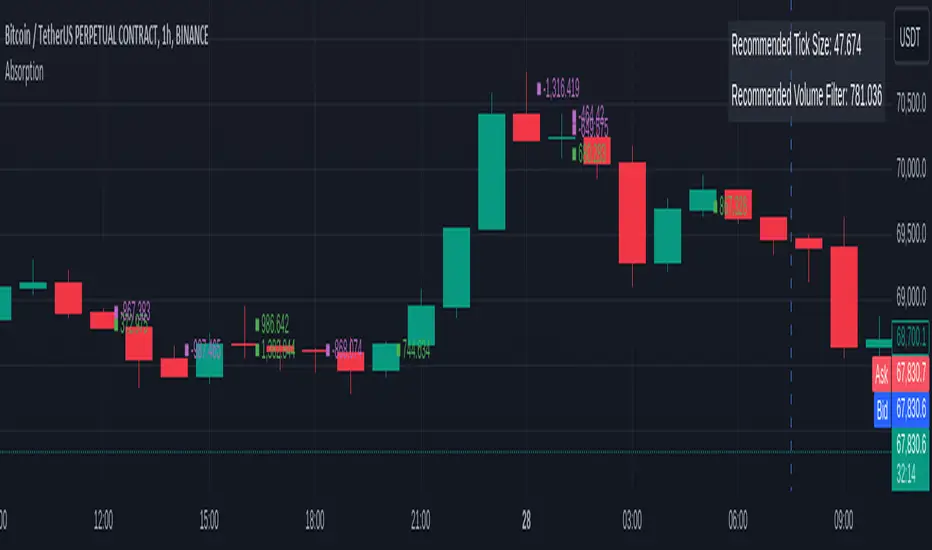
Delta Absorption Scanner[MarkitTick]💡 This advanced analytical tool is engineered to bridge the gap between price action and order flow dynamics by identifying critical moments where market participants encounter significant liquidity barriers. In the modern trading landscape, volume alone is often insufficient to determine market direction. The Delta Absorption Scanner provides a sophisticated lens through which traders can observe the interaction between aggressive market orders and passive limit orders, specifically highlighting "Absorption" events. These events occur when high-volume "Effort" fails to produce a proportional price "Result," signaling a potential exhaustion of the current trend or a hidden accumulation/distribution phase. By synthesizing volume delta, candle spread, and multi-timeframe context into a unified interface, this script empowers traders to make decisions based on the structural integrity of the market rather than superficial price movements.
✨ Originality and Utility
The primary utility of this script lies in its multi-layered approach to market analysis, moving beyond simple oscillators or trend-following moving averages.
Unlike standard volume indicators that merely report total activity, this scanner differentiates between buying and selling pressure by calculating candle-based delta, allowing for a more granular view of market intent.
The script introduces a unique "Scanner" architecture that monitors four distinct high-timeframe (HTF) perspectives simultaneously. This provides an institutional-grade view of the trend without the need to constantly switch chart intervals.
It incorporates a proprietary "Absorption" detection logic that correlates delta percentage with the physical spread of the candle. This identifies "hidden" strength or weakness that is often invisible to the naked eye.
The inclusion of Fair Value Gap (FVG) and Swing High/Low detection within the dashboard creates a comprehensive "Confluence Engine," ensuring that short-term delta signals are validated by higher-level market structures.
By utilizing non-repainting multi-timeframe logic (security calls with index offsets), the indicator maintains the highest standards of data integrity, making it suitable for both discretionary trading and systemic strategy development.
🔬 Methodology and Concepts
The core logic begins with the calculation of "Candle Delta," which determines the dominant force within a single bar based on its polarity. If a candle closes above its open, the entire volume is attributed to positive delta; if it closes below, it is negative.
The indicator then calculates the "Spread," defined as the absolute distance between the high and low of the bar. This metric is critical for the "Effort vs. Result" analysis.
Absorption is mathematically flagged when a candle exceeds the user-defined "Minimum Delta %" threshold but fails to generate significant directional movement, or when the spread is disproportionately small compared to the volume injected.
The Support (S3) and Resistance (R3) levels are derived from the most recent significant high-volume or high-delta bars, creating dynamic zones that reflect where institutional liquidity was last engaged.
Multi-Timeframe Integration: The script utilizes the request.security() function with a bar offset. This ensures that the data displayed from higher timeframes is "confirmed" and prevents the visual bias known as repainting.
Trend determination on the dashboard is calculated using a proprietary relationship between the current price and the 14-period smoothed high/low averages, providing a stable "Trend Bias" for each monitored timeframe.
● Main Feature Components
• Volume Delta labels
The script places dynamic labels above or below candles that exhibit significant delta. These labels display the Delta percentage, helping traders identify where "Climax" volume is occurring.
• Spread Analysis (S)
Next to the Delta % is a value representing the "Spread." This allows for an immediate visual comparison: High Delta with Low Spread suggests passive absorption (reversal), while High Delta with High Spread suggests aggressive momentum (continuation).
• Multi-Timeframe (HTF) Dashboard
A sophisticated table displayed on the chart that aggregates data from up to four higher timeframes. This dashboard is the "brain" of the scanner, providing a bird's-eye view of the market's broader health.
🎨 Visual Guide
Positive Delta Labels: Displayed as green labels with white text. These signify bars where buying volume was dominant.
Negative Delta Labels: Displayed as red labels with white text. These signify bars where selling volume was dominant.
Neutral/Spread Labels: Displayed in a dark neutral color to represent bars where the spread is being analyzed without a significant delta bias.
Dashboard - Trend Column: Displays "UP" in green for bullish regimes and "DN" in red for bearish regimes for each of the four HTF settings.
Dashboard - S3/R3 Column: Displays the price of the nearest significant support or resistance level identified by the script.
Dashboard - Distance % Column: A dynamic calculation showing how far the current price is from the S3/R3 levels. Green indicates distance from support, while red indicates distance from resistance.
Dashboard - FVG Column: Displays "+FVG" in green if a bullish Fair Value Gap exists on that timeframe, or "-FVG" in red if a bearish gap is present.
Dashboard - Swing Column: Identifies if the current price is near a local "Top" or "Bottom" based on pivot logic.
📖 How to Use
Step 1: Identify "Effort" on the Chart. Look for a large Delta % label (e.g., >20%) appearing at a local high or low.
Step 2: Analyze the "Result." If the Delta is high (Green/Positive) but the candle spread (S) is small and price fails to move higher, this is a classic Bearish Absorption signal. Limit sellers are "absorbing" the market buyers.
Step 3: Consult the Dashboard. Check if the HTF trends are in alignment. For a short trade based on Bearish Absorption, you ideally want to see "DN" trends on higher timeframes and the presence of a "-FVG."
Step 4: Proximity to S/R. Use the "Dist %" column to ensure you are not selling directly into a higher-timeframe support (S3) or buying directly into resistance (R3).
Step 5: Confluence. The highest probability trades occur when a Delta climax appears at a dashboard-confirmed Swing Top/Bottom in the direction of the HTF trend.
⚙️ Inputs and Settings
Positive/Negative Delta Color: Customizes the aesthetic of the bull/bear labels to match your chart theme.
Max Labels on Chart: Controls the lookback period for visual labels to maintain chart performance and reduce clutter.
Minimum Delta % to Show: A sensitivity filter. Higher values (e.g., 50%) will only show the most extreme volume events, while lower values (e.g., 10%) provide more frequent signals.
Show Spread (S): Toggles the visibility of the candle spread value within the labels.
HTF 1-4 Settings: Allows the user to define which timeframes the dashboard should track (e.g., 1H, 4H, Daily, Weekly).
Dashboard Position: Permits the user to move the table to different corners of the chart for better visibility.
🔍 Deconstruction of the Underlying Scientific and Academic Framework
• The Law of Effort vs. Result
Based on the principles established by Richard Wyckoff, this indicator quantifies "Effort" as Volume Delta and "Result" as Price Spread. In a balanced market, increased effort should lead to an equivalent result. When these two diverge (Anomalies), it suggests a change in market character.
• Auction Market Theory (AMT)
The indicator utilizes AMT principles by identifying areas of "High Volume Nodes" (represented by S3/R3) where the market has found value or met significant opposition. The "Distance %" feature measures the market's deviation from these nodes, which often acts as a mean-reversion catalyst.
• Order Flow Imbalance
While traditional indicators use price as a lagging derivative, the Delta Absorption Scanner attempts to lead price by observing the imbalance between aggressive market participants. By isolating the delta within each bar, the script identifies where one side of the "Auction" is becoming exhausted.
• Statistical Significance of Spread
The inclusion of spread analysis is rooted in statistical volatility measurements. A narrow spread during high volume indicates a high density of limit orders (Liquidity), which is a precursor to price reversals or significant breakouts once the liquidity is exhausted.
• Multi-Timeframe Structuralism
The scanner's architecture is based on the theory that lower-timeframe "noise" is resolved by higher-timeframe "structure." By mapping FVGs and Swings across four dimensions, the script applies a fractal analysis to the current bar's delta events.
⚠️ Disclaimer
All provided scripts and indicators are strictly for educational exploration and must not be interpreted as financial advice or a recommendation to execute trades. I expressly disclaim all liability for any financial losses or damages that may result, directly or indirectly, from the reliance on or application of these tools. Market participation carries inherent risk where past performance never guarantees future returns, leaving all investment decisions and due diligence solely at your own discretion.
Indicatore Pine Script®