Trend Targets Oscillator- Webhooks v1.8.3Trend Targets Oscillator - Webhooks v1.8.3
Overview
This technical indicator combines a momentum-based oscillator with statistical analysis of historical price behavior to generate trading signals and calculate position management levels. The indicator analyzes past price patterns to establish data-driven thresholds for entries, exits, and stop placement.
Key Components:
• Weighted momentum oscillator with trend-following characteristics
• Statistical percentile analysis for take profit level calculation
• Dynamic stop loss placement based on price structure and volatility
• Adaptive ranges (ATR-based) for dynamic support/resistance visualization
• Real-time performance tracking and historical signal analysis
Critical Disclaimer: This indicator performs technical analysis on historical data. Past patterns, statistics, and performance do not predict, indicate, or guarantee future results. All trading carries substantial risk of loss. This tool does not provide investment advice or trading recommendations.
Important Note: Calculations use standard OHLC data; results may differ on non-standard chart types (Heikin Ashi, Renko, Kagi, Point & Figure, Range).
Technical Methodology
1. Momentum Oscillator
Core Approach: The oscillator employs a weighted Relative Strength Index (RSI) methodology combined with Quantitative Qualitative Estimation (QQE) trailing stop concepts. This creates a momentum indicator that adapts to trending conditions while maintaining sensitivity to reversals.
How It Functions:
• Calculates directional price momentum using weighted price changes
• Applies directional bias to amplify movements aligned with the prevailing trend direction
• Uses a dynamic trailing stop mechanism adapted from QQE methodology to identify potential trend reversals
• Applies exponential moving average smoothing to reduce market noise
• Operates within configurable overbought/oversold threshold zones (default: 70/30)
Signal Generation Process:
• BUY signals occur when the oscillator line crosses above its trailing stop level
• SELL signals occur when the oscillator line crosses below its trailing stop level
• All signals confirm only at bar close, eliminating mid-bar fluctuations and repainting
Technical Parameters (All Configurable):
• RSI Length (default: 100 bars) - Controls the period for momentum calculation
• Stop Multiplier (default: 2.5) - Adjusts the sensitivity of the trailing stop mechanism
• Smoothing Length (default: 6 bars) - Reduces noise through exponential smoothing
• Directional Weight (default: 6.4) - Amplifies trend-aligned price movements
• Overbought/Oversold Levels (default: 70/30) - Defines momentum extreme zones
What This Component Does: This component identifies potential trend changes through momentum analysis, generates entry signals based on the interaction between an oscillator and a trailing stop, filters those signals using overbought and oversold zones, and confirms all signals at bar close to help prevent repainting.
What This Component Does Not Do: This component does not predict future price direction or guarantee signal accuracy or profitability, it cannot eliminate false signals entirely, and it will not perform equally well across all market conditions.
2. Statistical Take Profit Calculation
Methodology: Rather than using fixed risk-reward ratios, this indicator analyzes the Maximum Favorable Excursion (MFE) from historical signals to establish statistically-derived take profit levels using percentile (quantile) analysis.
Maximum Favorable Excursion (MFE) Concept: MFE measures how far price moved in the favorable direction after each historical signal before either reversing or hitting the stop loss. This creates a dataset of historical "best case" price movements for each direction.
Statistical Process:
• Maintains separate historical datasets for LONG signals and SHORT signals (markets behave differently in uptrends vs downtrends)
• Tracks MFE data from the last N signals (configurable, default: 20 signals per direction)
• Calculates percentiles (quantiles) from this historical MFE dataset
• Uses these percentiles to determine take profit distance from entry
Three Statistical Thresholds:
TP1:
• Default: 66th percentile of historical MFE data
• Meaning: Based on historical analysis, approximately 66% of similar past signals moved at least this far in the favorable direction
• Note: This is a statistical observation of past behavior, not a prediction that 66% of future signals will reach this level
TP2:
• Default: 50th percentile (median) of historical MFE data
• Meaning: Represents the middle point of historical favorable price movements
• Note: Past median values do not indicate future median performance
TP3:
• Default: 30th percentile of historical MFE data
• Meaning: Based on historical analysis, approximately 30% of similar past signals moved at least this far
Important Technical Notes:
• Percentile thresholds are fully configurable in settings (you can adjust 66/50/30 to any values)
• Requires minimum historical data (20+ signals per direction) for statistical relevance
• Falls back to configurable risk-reward ratio (default 1.5R) when insufficient historical data exists
• Recalculates dynamically as new signals complete and add to the historical dataset
• "R" represents Risk units (distance from entry to stop loss)
What This Component Does: This component analyzes historical price behavior patterns and calculates statistical percentiles from past favorable movements to establish take-profit levels based on observed historical data. It adapts to the specific instrument and timeframe being analyzed, and it separates its analysis for long versus short signals.
What This Component Does Not Do: This component does not predict where future price will reach or guarantee any specific hit rate or success percentage, and it cannot ensure profits on any individual trade. It also does not account for changing market conditions or regime shifts, and it does not replace the need for proper risk management and position sizing.
3. Dynamic Stop Loss Placement
Methodology: Stop loss calculation combines Donchian Channel logic with Average True Range (ATR) volatility adjustment to create stops that respect recent price structure while accounting for normal market fluctuations.
How It Functions:
Donchian Channel Component:
• Identifies the highest high and lowest low over a specified lookback period (default: 20 bars)
• For LONG signals: Uses the lowest low as the base for stop placement
• For SHORT signals: Uses the highest high as the base for stop placement
• This respects recent price structure and support/resistance levels
ATR Volatility Buffer:
• Calculates the Average True Range over 14 periods to measure current volatility
• Adds a configurable buffer (default: 1.0 × ATR) beyond the Donchian extreme
• For LONG signals: Stop = Donchian Low - (ATR × Buffer Multiplier)
• For SHORT signals: Stop = Donchian High + (ATR × Buffer Multiplier)
• This prevents premature stop-outs from normal price volatility
Technical Parameters (All Configurable):
• Donchian Length (default: 20 bars) - Period for identifying recent price extremes
• SL Buffer Multiplier (default: 1.0 × ATR) - Distance beyond Donchian extreme (0.0 to 5.0)
What This Component Does: This component places stops based on recent price structure using Donchian extremes, adjusts them to reflect current volatility via an ATR-based offset, and adapts dynamically as conditions change. It includes a configurable buffer to suit different trading styles and is designed to respect key technical support and resistance levels.
What This Component Does Not Do: This component does not guarantee that a stop loss will not be hit, nor can it prevent slippage, gaps, or other execution-related risks. It does not ensure a favorable risk-reward outcome on every trade, does not account for fundamental events or news releases, and it does not replace the need for proper position sizing and overall capital management.
4. Adaptive Ranges (ATR-Based)
Methodology: The indicator includes an optional overlay that displays adaptive support and resistance zones based on Average True Range (ATR) volatility measurements. These ranges adjust dynamically as price moves beyond volatility thresholds.
How It Functions:
• Calculates an adaptive moving average that shifts when price moves beyond ATR-based thresholds
• Displays five levels: Upper Resistance 2 (R2), Upper Resistance 1 (R1), Middle (AVG), Lower Support 1 (S1), Lower Support 2 (S2)
• Zones are created using ATR multiples above and below the adaptive average
• When price breaches the outer boundaries significantly, the entire range structure recalculates and repositions
Technical Parameters (All Configurable):
• Length (default: 50 bars) - Period for ATR calculation
• Factor (default: 6.0) - Multiplier for ATR to set zone width
• Source (default: close) - Price data used for calculations
• Show (default: ON) - Toggle visibility
Purpose and Use:
• Provides context for potential reversal or consolidation areas
• Can complement the statistical TP levels by showing additional resistance/support
• Helps visualize market volatility expansion and contraction
• Creates dynamic zones that adapt to changing volatility conditions
What This Component Does: This component displays volatility-adjusted support and resistance zones, adapt dynamically to price movement and changing volatility, providing visual context for potential reversal areas. The segments update when price moves beyond defined threshold boundaries.
What This Component Does Not Do: This component does not predict future support or resistance levels, does not guarantee that reversals will occur at zone boundaries, or replace traditional support and resistance analysis. It also does not account for fundamental catalysts or news-driven events that can override technical behavior.
Visual Components and Displays
Oscillator Panel (Lower Pane)
The oscillator displays in a separate pane below the price chart with the following elements:
• Main Oscillator Line (teal/green): Shows current momentum state
• Trailing Stop Line (purple): Dynamic support/resistance level that triggers signals
• Overbought/Oversold Zones: Horizontal threshold lines (default 70/30)
• Historical Signal Markers: BUY (green triangles up) and SELL (red triangles down) where signals occurred
Reading the Display:
- When oscillator crosses above trailing stop = BUY signal generated
- When oscillator crosses below trailing stop = SELL signal generated
- Oscillator in upper zone (>70) = momentum in overbought territory
- Oscillator in lower zone (<30) = momentum in oversold territory
On-Chart Overlays (Price Chart)
For each historical signal, the indicator displays visual overlays on the main price chart:
Entry Line (Yellow):
- Horizontal line showing the price level where the signal was generated
- Helps identify the actual entry point
Stop Loss Line (Red):
- Horizontal line showing the calculated stop loss level
- Based on Donchian + ATR methodology described above
Three Take Profit Zones (Green for LONG / Red for SHORT):
- TP1 Zone: Lightest shade - conservative percentile target
- TP2 Zone: Medium shade - moderate percentile target
- TP3 Zone: Darkest shade - aggressive percentile target
- Zones displayed as shaded rectangular areas extending forward from signal
Visual historical overlays: This provides visual feedback on historical signal performance and helps assess whether the statistical methodology is appropriate for the current instrument and timeframe.
These visual overlays allow you to see: These visual overlays allow you to see where historical signals occurred and at what price, where stops were placed according to the methodology, and where statistical take-profit levels were calculated. They also show which targets were reached versus not reached, how price behaved relative to the statistical projections, and the adaptive support/resistance context that frames overall market structure.
Statistics Table (Real-Time Analysis)
The indicator displays a comprehensive statistics table (typically in the upper-right corner) showing performance metrics for historical signals.
Table Header: "Historical stats (not predictive) under current settings"
Performance Metrics (Separate rows for BUY and SELL): For the Last N Signals (default: last 20 BUY and last 20 SELL separately):
Column Headers:
• Signal: Direction (BUY or SELL)
• Win: Count of signals where at least one take profit was reached before stop loss
• Loss: Count of signals where stop loss was hit before any take profit was reached
• TP1 Hit: Percentage of signals that reached the first take profit level
• Δ1%: Average percentage distance from entry to TP1, calculated only for signals that actually reached TP1
• TP2 Hit: Percentage of signals that reached the second take profit level
• Δ2%: Average percentage distance from entry to TP2, calculated only for signals that actually reached TP2
• TP3 Hit: Percentage of signals that reached the third take profit level
• Δ3%: Average percentage distance from entry to TP3, calculated only for signals that actually reached TP3
Understanding the Distance Metrics:
The "Dist%" columns show the average percentage gain (from entry price to TP level) for only those trades that successfully reached that specific TP level. This helps you understand the typical profit magnitude when that target is hit.
Footer Message (Historical Performance Evaluation): The table displays one of three messages based on historical loss percentage:
✅ "Historical performance threshold met. Based on past data under current settings. Not a recommendation."
- Displayed when both LONG and SHORT directions show less than 40% losses on past historical data on this specific instrument and timeframe
- indicates the loss-rate is below the configured threshold (40% losses) for both directions over the last N historical observations (descriptive only).
🛑 "Historical performance below threshold. Based on past data under current settings. Not a recommendation."
- Displayed when both LONG and SHORT directions show more than 40% losses on past historical data on this specific instrument and timeframe
- indicates the loss-rate is above the configured threshold (40% losses) for both directions over the last N historical observations (descriptive only).
⚠️ "Historical performance: Mixed / higher risk. Based on past data under current settings. Not a recommendation."
- Displayed when one direction is <40% loss and one is >40% loss on past historical data on this specific instrument and timeframe
- indicates a mixed result: one direction is above and the other is below the threshold over the last N historical observations (descriptive only).
These statistics and messages are descriptive of past historical performance for the specific instrument and timeframe being analyzed, and they are provided purely as informational tools to help you understand how the indicator behaved historically. They are based solely on historical data analysis and can change over time as new signals complete and the underlying dataset updates.
These statistics and messages are not predictions of future performance, trading recommendations or advice, or guarantees of profitability. They do not indicate that past results will repeat, and they should not be interpreted as suggestions to enter trades or to avoid them.
The footer message helps you understand whether the current settings and statistical thresholds have shown historically favorable or unfavorable results on this particular market. However, past favorable statistics do not ensure future favorable results, and past unfavorable statistics do not ensure future unfavorable results.
Configuration Options
All parameters are fully adjustable in the indicator settings. Default values are provided as starting points and may require optimization for different instruments and timeframes.
Oscillator Parameters
• RSI Length (default: 100)
Controls the period used for momentum calculation. Higher values = smoother, slower momentum readings. Lower values = more responsive, potentially noisier readings.
• Stop Multiplier / QQE Factor (default: 2.5)
Controls sensitivity of the trailing stop mechanism. Higher values = wider trailing stop, fewer signals, more trend-following. Lower values = tighter trailing stop, more signals, more sensitive to reversals.
• Smoothing Length (default: 6)
EMA smoothing applied to reduce noise. Higher values = smoother oscillator line. Lower values = more responsive to price changes.
• Directional Weight (default: 6.4)
Amplification factor for trend-aligned movements. Higher values = stronger bias toward current trend direction. Lower values = more balanced, less trend-biased.
• Source (default: close)
Price data used for calculations (close, open, high, low, hl2, hlc3, ohlc4).
Threshold Parameters
• Overbought Level (default: 70)
Oscillator level considered overbought. Range: 0-100. Used for signal filtering and visual reference.
• Oversold Level (default: 30)
Oscillator level considered oversold. Range: 0-100. Used for signal filtering and visual reference.
Statistical Analysis Parameters (Historical Percentile Targets)
• Lookback N Trades (default: 20)
Number of historical signals to include in statistical analysis. Analyzed separately for LONG and SHORT. Higher values = more stable statistics, slower adaptation. Lower values = more adaptive, potentially less stable statistics. Minimum: 5 signals.
• TP1 Target Percentile (default: 66)
Percentile of historical MFE data used for first take profit. Range: 1-99. 66 means ~66% of historical signals reached at least this distance. Higher percentile = more conservative target (closer to entry). Lower percentile = more aggressive target (farther from entry).
• TP2 Target Percentile (default: 50)
Percentile of historical MFE data used for second take profit. 50 = median of historical favorable movements. Adjust based on desired risk-reward profile.
• TP3 Target Percentile (default: 30)
Percentile of historical MFE data used for third take profit. 30 means ~30% of historical signals reached at least this distance. More aggressive, historically reached less frequently.
• Fallback TP (default: 1.50 R)
Risk-reward ratio used when insufficient historical data exists. "R" = Risk units (distance from entry to stop loss). 1.50 R = take profit placed at 1.5× the distance to stop loss. Used until enough signals accumulate for statistical calculation.
Note on Percentile Configuration:
You can customize these percentiles to match your trading style:
- Conservative approach: Use higher percentiles (e.g., 80/60/40) for closer, more frequently reached targets
- Aggressive approach: Use lower percentiles (e.g., 50/30/15) for extended targets with lower historical hit rates
- Balanced approach: Default values (66/50/30) provide middle ground
Stop Loss Parameters
• Donchian Length (default: 20)
Lookback period for identifying recent price extremes. Higher values = stops based on longer-term structure. Lower values = stops based on shorter-term swings.
• SL Buffer (× ATR) (default: 1.00)
Multiplier for ATR-based volatility buffer. Range: 0.0-5.0. 1.0 = stop placed one ATR beyond Donchian extreme. Higher values = wider stops, less risk of premature stop-out. Lower values = tighter stops, higher risk of normal volatility hitting stop.
Adaptive Ranges (ATR-Based) Parameters
• Length (default: 50)
Period for ATR calculation used in adaptive range zones. Higher values = zones based on longer-term volatility. Lower values = zones more responsive to recent volatility changes.
• Factor (default: 6.0)
Multiplier applied to ATR for determining zone width. Higher values = wider zones, farther from average. Lower values = tighter zones, closer to average.
• Source (default: close)
Price data used for adaptive average calculation.
• Show (default: ON)
Toggle visibility of adaptive range overlays on chart. Turn OFF for cleaner chart if you only want oscillator signals.
Visual Display Parameters
• Show Historical B/S Markers (Pane) (default: ON): Displays BUY/SELL triangles in oscillator panel.
• Show B/S on Price Chart (default: ON): Displays BUY/SELL markers on main price chart.
• Show History TP/SL Overlays (default: ON): Displays entry lines, stop lines, and TP zones on price chart. Turn OFF for cleaner chart if you only want the oscillator signals.
• History Segment Length (Bars) (default: 20): How many bars forward the TP/SL overlays extend from signal. Range: 5-200 bars. Does not affect calculations, only visual display duration.
Initial Setup and Learning Period
1. Adding Indicator to Chart
The indicator can be applied to any instrument and timeframe. Default settings are provided as a starting point.
2. Data Collection Period
The statistical analysis requires historical signals to function. Typically 20+ bars provide initial data, while 50-100+ bars may produce more robust statistics. The table displays "Not enough data yet to evaluate" until sufficient signals exist.
3. Observing Initial Performance
Signals develop over time. The calculated TP levels appear relative to actual price movement. Historical statistics show which direction (LONG vs SHORT) has performed differently. The statistics table displays historical behavior patterns.
4. Statistical Data Accumulation
The indicator accumulates historical data over time. Some traders choose to observe performance in paper trading or demo environments before live use. Understanding the methodology involves reviewing how calculations work on historical data.
Webhook Integration and Alerts
The indicator includes alert functionality for integration with automated trading systems and notification services.
Alert Characteristics:
• Alerts trigger only when signals confirm at bar close (no mid-bar alerts)
• Respects the historical performance evaluation footer status
• Includes symbol, timeframe, and direction information in alert message
• Provides JSON-formatted data for easy parsing by automated systems
• Separate alert events for: Entry, TP1, TP2, TP3, Stop Loss, Early Close (Win/Loss)
Alert Events Available:
- Entry: When a new signal is generated
- TP1/TP2/TP3: When each take profit level is reached
- SL: When stop loss is hit
- Early Close Win: When position closes early in profit (without hitting TP or SL)
- Early Close Loss: When position closes early at a loss (without hitting TP or SL)
JSON Data Structure:
Each alert contains structured data including:
• Event type (Entry, TP1, TP2, TP3, SL, etc.)
• Direction (long/short)
• Symbol and timeframe
• Price levels (entry, stop, take profits)
• Timestamps (entry time, event time)
• Duration (milliseconds and minutes from entry to event)
Compatible With:
• Third-party webhook automation platforms and tools that support TradingView webhooks
• Custom trading bot implementations via webhook endpoints
• Notification systems that can receive TradingView alerts
• Any service supporting webhook integration through TradingView's alert system
The author and indicator provider assume no responsibility for losses incurred through automated trading, alert-based systems, webhook implementations, or any third-party integrations. Users are solely responsible for their trading decisions, automation setup, risk management, and system monitoring.
What This Indicator Is and Is Not
What This Indicator Is:
This indicator is a technical analysis tool that combines momentum oscillation with statistical analysis, using a signal-generation methodology built on weighted RSI and QQE concepts. It calculates take-profit levels through historical percentile analysis, places stop losses based on both price structure and volatility, and displays adaptive support/resistance zones derived from ATR. In addition, it tracks and presents historical signal performance and serves as an educational resource for understanding statistical approaches to trading. For accurate results, it requires standard OHLC chart data.
What This Indicator Is Not:
This indicator is not a prediction system or “fortune-telling” tool, nor is it a guaranteed profit generator or a “holy grail” trading system. It does not provide investment advice or financial recommendations, and it is not a substitute for proper education and solid risk management. It may not be suitable for every trader, market, chart type, or market condition, and it is not a replacement for human judgment and decision-making. It also cannot eliminate the possibility of losses, drawdowns, or periods of underperformance, and it is not designed for or tested on non-standard chart types—so results may differ when used outside standard charts.
Who This Indicator Is Designed For
May Be Suitable For:
This indicator may be suitable for traders who prefer systematic, rules-based approaches and want to incorporate statistical analysis into their trading, especially if they’re looking for a methodology that adapts to historical price behavior. It’s best for users who are comfortable with technical analysis concepts, can manage risk and position sizing properly, and are willing to invest time in testing and optimization. It also fits those who understand that past results don’t guarantee future performance and who use standard OHLC charts for their analysis.
May Not Be Suitable For:
This indicator may not be suitable for absolute beginners with no trading experience, or for traders looking for guaranteed profits and “get rich quick” systems. It’s also not ideal for those who are uncomfortable with technical analysis or statistical concepts, who cannot tolerate losses or drawdown periods, or who are unwilling to spend time learning, testing, and refining the methodology. Additionally, it may not fit users seeking a fully automated “set and forget” solution, traders who don’t follow proper risk management principles, or those who primarily work with non-standard chart types.
Important Limitations and Considerations
Technical Limitations:
This indicator has several technical limitations: it requires sufficient historical data for its statistical calculations to work properly, and its performance can vary significantly across different instruments and timeframes. It may perform poorly in ranging, choppy, or low-liquidity markets, and the statistical percentiles it uses are derived from past data that may not reflect future behavior. Depending on market conditions, signals can cluster or become sparse, and no technical system performs equally well across all regimes. Results may also differ on non-standard chart types (such as Heikin Ashi, Renko, Kagi, Point & Figure, or Range charts), and while the adaptive ranges adjust to volatility, they cannot predict regime changes.
Market Limitations:
This indicator has market-related limitations because it cannot account for fundamental events, news, or black swan scenarios, and it does not incorporate market sentiment, positioning, or order flow. Historical statistical patterns can break down during regime shifts, and as market structure evolves, past behaviors may not persist. External drivers such as geopolitical developments or policy changes are also outside its scope, and risks from gaps as well as weekend or overnight moves are not explicitly factored into its calculations.
Execution Limitations:
This indicator has execution limitations because it does not account for slippage, spread, or execution delays, and it cannot guarantee fills at the calculated levels. It also does not explicitly factor in gap risk or overnight holding risk, and it assumes there is sufficient liquidity to execute orders as intended. In addition, it cannot account for exchange outages or other technical failures, and webhook or alert delivery can fail due to connectivity problems or third-party system issues.
User Limitations:
This indicator also has user-related limitations: it requires the discipline to follow signals consistently rather than overriding them emotionally, along with proper position sizing and risk management. Users need the psychological resilience to handle losing streaks and the time to monitor performance and evaluate results on an ongoing basis, especially if using alerts or automation. It also assumes sufficient capital and emotional reserves to withstand drawdowns, as well as a clear understanding of the constraints of standard OHLC charts.
Risk Warnings and Disclaimers
Please Read This Section Carefully
General Trading Risks: Trading and investing involve substantial risk of loss, and you can lose some or even all of your invested capital. Past performance does not indicate, predict, or guarantee future results, and no trading system, indicator, or methodology can eliminate risk. Markets are inherently unpredictable and uncertain, so outcomes can vary widely even when using a consistent approach.
Specific Risks Related to This Indicator: Its historical statistics and percentile calculations are inherently backward-looking, not forward-looking, and past favorable results do not ensure future favorable results. Market conditions can change, historical patterns may stop working or fail to repeat, and statistical analysis cannot predict future price movements. As a result, the indicator can generate losing signals and experience unprofitable periods, with no guarantee of any particular win rate, profit level, or overall performance. Metrics such as “Dist%” reflect historical averages and should not be interpreted as future profit guarantees, while adaptive ranges reflect historical volatility behavior not future support or resistance. Results may also differ significantly when used on non-standard chart types.
What This Indicator Does Not Guarantee: This indicator does not guarantee profitable trades or positive returns, any specific win percentage, success rate, or profit distance, or protection from losses and drawdowns. It also cannot guarantee that historical statistics will persist into the future, that it will be suitable for your specific financial situation, or that it will match your risk tolerance or trading goals. In addition, it does not guarantee reliable operation when used with automated trading systems, nor does it guarantee consistent results across different chart types.
Regulatory Disclaimer:
This indicator is a technical analysis tool for educational and informational purposes only. It does not constitute: Investment advice or recommendations, Financial planning or wealth management services, A solicitation to buy or sell any securities or instruments, A guarantee or warranty of any kind regarding performance, Professional advice tailored to your specific situation
Legal Liability:
By using this indicator, users acknowledge and agree that they are solely responsible for all trading decisions and outcomes, and that the author and indicator provider assume no liability for any losses or damages. Users confirm that they have read and understood all stated risks and disclaimers, agree not to hold the author or provider responsible for any results, and recognize that trading can result in the total loss of capital. They also understand the limitations related to chart types and the indicator’s calculation methods, which may affect how results are produced and interpreted.
Geographic Restrictions:
This indicator may not be suitable or legal in all jurisdictions. It is your responsibility to ensure compliance with local laws and regulations regarding trading and financial markets.
Final Statement
This indicator represents a systematic approach to technical analysis that combines momentum oscillation with statistical analysis of historical price behavior and adaptive volatility-based ranges. It is designed to provide a structured framework for visualizing historical market conditions and statistical behavior under the selected settings.
Access and Support Information
This is an invite-only indicator. For access requests, detailed documentation, setup guides, and ongoing support, please refer to the author's signature field displayed below this publication.
Thank you for taking the time to read this complete description. Understanding the methodology, limitations, and proper usage is essential for anyone considering using this indicator.
Trade safely and responsibly.
Buy

Mounir Delta Wave HistogramMounir Delta Wave Histogram is a professional volume-based indicator designed to visualize directional market waves using estimated volume delta.
It accumulates buying and selling pressure across price movements to form clear histogram blocks that represent bullish and bearish waves. Each wave displays:
• Total traded volume
• Volume delta (buyers vs sellers)
• Delta percentage
• Time duration of each wave
This allows traders to quickly identify:
✔ Strong momentum moves
✔ Hidden divergence between price and volume
✔ Trend continuation and exhaustion
✔ Shifts in market pressure
The indicator offers multiple display modes, customizable colors, wave inversion options, and alert conditions for key thresholds and new wave formations.
📊 Compatible with all markets including Futures, Forex, Crypto, Stocks, and Indices — anywhere volume data is available.
Ideal for:
• Order flow analysis
• Momentum trading
• Scalping & swing trading
• Trend confirmation

[Algoros] Bitcoin Profit ScoutBitcoin Profit Scout v4.3.1 — How to use
Purpose: a BTC daily “buy the dips / sell the rips” guide using Buy/Sell Trigger Lines + confirmed signal shapes + optional Signal Barometer.
1) Required setup (important)
Symbol : Best results on BITSTAMP:BTCUSD . Also supports BTCUSD, BTCEUR, BTCCHF, BTCGBP, BTCAUD, BTCJPY.
Timeframe : 1D (Daily) .
Chart type : Standard candles or line (avoid non-standard chart types).
If you pick the wrong symbol/timeframe/type, BPS will show an on-chart error message and hide signals/lines.
2) What the lines mean
Buy Trigger Line : prices below this line are the “Buy Zone”.
Sell Trigger Line : prices above this line are the “Sell Zone”.
3) Market modes (visual cues)
Bull Market Mode (green emphasis): “Buy Zone” is less strict.
Bear Market Mode (teal/aqua emphasis): “Buy Zone” is stricter (deeper downside needed).
Hype Market Mode (red emphasis): sell logic can become stricter; special “blow-off” logic can apply.
4) Signals (shapes) and how to act
Buy signals (below candles)
Small Buy (green triangle, tiny): early/smaller dip buy.
Buy (green triangle, small): stronger dip buy.
Strong Buy (aqua/teal triangle): bear-market style buy (typically deeper undervaluation).
Golden Buy (yellow triangle): rare, deep-cycle accumulation style signal.
Blow-Off Buy (green diamond): buy signal during hype/blow-off conditions when a dip is attractive.
Sell signals (above candles)
Sell (red triangle, tiny): regular sell / take-profit signal.
Sell (Blow-Off) (red triangle, larger): blow-off top style sell signal.
BM Sell (red X-cross): bear-market “soft sell” / risk-off sell signal.
Practical usage idea (simple and robust)
Context first : use the trigger lines to see whether price is in Buy Zone or Sell Zone.
Wait for confirmation : act on the signal shapes (not just touching a line).
Scale in/out : consider multiple entries on buy signals and partial exits on sell signals (instead of all-in/all-out).
5) “Show Signals…” (reducing repaint surprises)
when they appear : signals can appear intraday and may vanish before the daily candle closes.
on the day of action : signals are shown after the daily candle closes (confirmed; plotted 1 day later).
Tip: If you want the cleanest, least-surprising signals, use on the day of action .
6) Signal Barometer (optional)
Show Signal Barometer : displays Buy and Sell likelihood for the current daily candle from 0–10.
How to interpret : 0 = unlikely, 10 = very likely / a signal is present.
Highlight historical barometer : visually highlights candles when the barometer is above your chosen threshold (commonly 8–10).
7) Alerts (TradingView)
Buy
Strong Buy
Golden Buy
Sell (includes bull sells, blow-off sells, and BM sells)
Altcoins
BPS is BTC-focused. If you want similar signal-style analysis on altcoin charts, use the separate Altcoin Profit Scout indicator (where available to you).
Free video walkthrough + deeper explanations
If you want a step-by-step video walkthrough and additional explanations/examples for Bitcoin Profit Scout, you can access them on our website (free): algoros.ai
Notes / expectations
BPS is designed for daily BTC charts . Using other timeframes or non-BTC symbols will degrade results and may hide signals.
Signals are based on multiple data sources (e.g., funding proxies and on-chain SOPR). Occasional data delays from providers can shift timing.
This is not financial advice; use risk management and position sizing.

EMA Buy/Sell & Smart Zones(5Min TF only)### **Indicator Title:**
**EMA Buy/Sell & Smart Zones**
---
### **Description:**
**EMA Buy/Sell & Smart Zones** is a specialized intraday trading tool designed to combine trend analysis with precise market structure zones. This script utilizes a custom tracking algorithm to identify the **specific candle** that formed the previous session's high or low, allowing it to plot accurate Supply and Demand zones for the current trading day.
This indicator has been rigorously tested on the **Nifty Index** and is optimized for use on the **5-minute timeframe**.
### **Key Features**
**1. Smart Session Wick Zones ("True Wick" Logic)**
The indicator automatically scans every candle of the previous session to locate the exact price action that formed the day's extremes.
* **Smart High Zone:** Identifies the specific candle that made yesterday's High and plots a zone from that High down to that candle's Open or Close (based on body direction).
* **Smart Low Zone:** Identifies the specific candle that made yesterday's Low and plots a zone from that Low up to that candle's Open or Close.
* **Close Range:** Highlights the High-Low range of the very last candle of the previous session to show the closing sentiment.
*All zones automatically stop extending at the end of the current session, ensuring the chart remains clean and historically accurate.*
**2. EMA Trend System**
The script plots three key Exponential Moving Averages to define market direction:
* **EMA 21:** Captures short-term momentum.
* **EMA 63:** Defines the medium-term trend.
* **EMA 1575:** Establishes the long-term baseline.
**3. Buy/Sell Signals**
Clear signals are generated on the chart based on specific criteria:
* **BUY Signal:** Generated when a green candle closes above the EMA 21 and EMA 63.
* **SELL Signal:** Generated when a red candle closes below the EMA 21 and EMA 63.
* *Note: The logic includes a filter to alternate signals (Buy -> Sell -> Buy), preventing clutter during choppy markets.*
### **How to Use**
* **Recommended Timeframe:** **5 Minutes**.
* **Recommended Markets:** Indices (Nifty, Bank Nifty) and high-volume stocks.
* **Workflow:**
* Use the **Smart Zones** (Red/Green boxes) to identify potential rejection areas or breakout targets.
* Use the **Buy/Sell Labels** as confirmation triggers when price is reacting near these zones or trending strongly above/below the EMAs.
### **Settings & Customization**
* **Visibility Control:** Toggle each box type (High, Low, Close) and text labels on or off individually.
* **Color Customization:** Fully adjustable colors for all EMAs, Zone Backgrounds, Borders, and Text Labels to suit your chart theme.
* **Label Size:** Adjust the text size of the zone labels directly from the settings menu.
---
**Disclaimer:** This tool is for educational purposes and should be used to assist your analysis. Always manage your risk appropriately.

Winners Scalper Pro - Bull/Bear (v1.5)best settings all standart but only change rsi
15 min rsi 8-9
30 min rsi 12-14

Master Cycle: Quantum Wave# AI Smart Signal: Quantum Wave Edition
**The Ultimate Market Co-Pilot: Precision Trend & Momentum Synthesis**
The **Quantum Wave** is not just another moving average; it is a sophisticated **Double-Smoothed Heiken Ashi Oscillator** designed to mathematically filter out market noise and visualize the true underlying trend structure.
This script combines three powerful engines into one "Master" system:
1. **Quantum Cycle Logic:** A proprietary algorithm that smooths price action to reveal the dominant "Heartbeat" of the market.
2. **Adaptive Momentum Visuals:** Dynamic dot sizing that reacts to volatility expansion and contraction.
3. **Smart Regime Filtering:** An AI-driven filter (ADX & Volatility) that automatically suppresses signals during dangerous "Choppy" or sideways markets.
---
## 🔬 Scientific Methodology
### 1. The Quantum Smoothing Algorithm
Most indicators suffer from "Whipsaws" (fake signals) because they react to every candle wick. The Quantum Wave solves this by creating a **Synthetic Price Series**.
* **Step 1:** It normalizes Open, High, Low, and Close data.
* **Step 2:** It applies a dual-layer Exponential Smoothing filter.
* **Result:** A clean, flowing "Ribbon" that ignores noise and only turns when the actual trend structure shifts.
### 2. Dynamic Momentum Sizing (The "Living" Dots)
The visual dots on the chart are "alive". They resize in real-time based on the **Body Strength** of the movement:
* 🔵 **Small Dots (Weak/Range):** Indicates the market is resting or deciding. *Guidance: STAY OUT / WAIT.*
* 🟢 **Medium Dots (Trend):** Indicates a confirmed healthy trend. *Guidance: ENTER / HOLD.*
* 🟡 **Large Dots (Power):** Indicates a high-volatility expansion phase. *Guidance: MAX PROFIT POTENTIAL.*
---
## 🛠️ Key Features
* **Instruction Overlay:** A built-in Dashboard tells you exactly what to do (BUY, SELL, HOLD, or WAIT) based on complex logic, simplified into one word.
* **Auto-Timeframe Detection:** The sensitivity automatically adjusts whether you are scalping (1-min) or Swing Trading (Daily).
* **Market Structure Labels:** Automatically identifies Higher Highs (HH) and Lower Lows (LL) to confirm trend direction.
* **Demand & Supply Zones:** Auto-plots key reaction levels for Take Profit targets.
---
## 🎯 How to Trade
**For a BUY Setup:**
1. **Trend:** Ensure the Quantum Wave (Dots) are **GREEN**.
2. **Momentum:** Look for the dots to grow from Small to Medium.
3. **Confirmation:** Wait for the Dashboard to read "ACTION: BUY".
**For a SELL Setup:**
1. **Trend:** Ensure the Quantum Wave (Dots) are **RED**.
2. **Momentum:** Look for the dots to grow from Small to Medium.
3. **Confirmation:** Wait for the Dashboard to read "ACTION: SELL".
---

MidZone Breakout Pro 🚀 MidZone Breakout Pro — Smart Balance Zone Signals
🧭 Equilibrium-Based Market Insight
MidZone Breakout Pro identifies key balance levels in the market and highlights directional opportunities when price decisively moves away from equilibrium.
📐 Dynamic Midpoint Zone Mapping
Automatically plots a central price balance zone derived from recent market ranges, helping traders visualize fair value and expansion areas.
🎯 Clear Buy & Sell Signals
Generates clean bullish and bearish signals when price exits the balance zone with momentum.
🎨 High-Visibility Zone Visualization
Color-coded zones, background shading, and bold signal markers provide instant clarity without chart clutter.
🎚 Customizable Sensitivity
Adjustable lookback period and zone width allow seamless adaptation across scalping, intraday, and swing trading.
🕰 Non-Repainting Signals
All signals are calculated using confirmed price action and remain stable on historical charts.
⚡ Lightweight & Fast Performance
Optimized design ensures smooth performance across all instruments and timeframes.
🛠 How to Use (Safe Version)
📉 **Buy Signal**: Appears when price moves strongly above the balance zone
📈 **Sell Signal**: Appears when price moves strongly below the balance zone
🟨 **Neutral Zone**: Indicates consolidation or equilibrium conditions
Best used in combination with trend direction, support/resistance, or volume confirmation.
⚠️ Disclaimer: This indicator is for educational and analytical purposes only. It does not provide financial advice. Always apply proper risk management.

Super Indicator v12 - Scalper EngineSuper Indicator and buy sell signal for scalping
Dual Supertrend confirmation
• EMA trend structure
• MACD/RSI/VWMA filters
• Candle coloring
• Buy Sell Arrows
Disclaimer:
This script is for educational purposes only. Trading involves risk, and past performance does not guarantee future results. Please test thoroughly and use at your own discretion. You are solely responsible for your trading decisions.

QSS v15.0 [Omni-Engine]# **QSS v15.0 | Institutional Quant System**
### **💎 The Only Indicator You Will Ever Need**
**QSS (Quantitative Signal System) v15.0** is an all-in-one algorithmic trading engine designed to solve the biggest problem in trading: **fragmentation.** Instead of cluttering your chart with 10 different indicators (RSI, MACD, Bollinger Bands, Order Blocks, SuperTrend, etc.), QSS synthesizes them all into a single, high-probability decision engine.
This is not just a "Buy/Sell" indicator. It is a complete **Institutional Trading Suite** that combines "Smart Money Concepts" (SMC) with quantitative trend analysis and dynamic risk management.
---
### **🚀 Key Features**
#### **1. Dual-Core Signal Engine**
Choose your weapon based on the asset class and volatility:
* **Engine A: SuperTrend (Classic):** The industry standard for capturing major trends. Best for Swing Trading and Stocks.
* **Engine B: OTT (Optimized Trend Tracker):** A faster, volatility-adaptive engine derived from VIDYA (Variable Index Dynamic Average). Best for Crypto and Scalping.
#### **2. Institutional Intelligence (SMC)**
* **Volumized Order Blocks (SMC):** Automatically detects Supply (Red Box) and Demand (Green Box) zones based on pivot volume.
* *Smart Filter:* The system will **BLOCK** Buy signals if price is running straight into a Bearish Order Block (Resistance).
* **Koncorde (Smart Money Flow):** Analyzes PVI (Positive Volume Index) vs. NVI (Negative Volume Index) to track "Sharks" (Institutions) vs. "Minnows" (Retail).
* *Smart Filter:* Signals are only generated if Institutional Money Flow supports the direction.
#### **3. The "Power 3" Confirmation Suite**
Includes optional filters for the classic trinity of technical analysis:
* **MACD:** Ensures momentum alignment.
* **Stochastic:** Prevents buying at overbought peaks.
* **Bollinger Bands:** Ensures trades only occur during volatility expansion (Squeeze breakout).
#### **4. Advanced Noise Filtering**
* **ADX Trend Strength:** Blocks signals during "dead" or choppy markets (ADX < 20).
* **Candle Stability Index:** Ignores "wicky" candles and indecision dojis, preventing fake-outs.
* **Trend Ribbon:** A dual-SMA cloud (21/34) that ensures you are always on the right side of the macro trend.
#### **5. Dynamic Risk Management (R:R)**
* Automatically calculates **Stop Loss** and **Take Profit** targets based on market volatility (ATR).
* **TP1 (1:1):** Secure profit / Move stops to breakeven.
* **TP2 (1:2):** Standard target.
* **TP3 (1:3):** Trend runner.
* *Visuals:* Draws clear entry, stop, and target lines on the chart when a trade is active.
#### **6. Pro Dashboard**
A dynamic panel that monitors:
* **Trend Status:** (Bullish/Bearish)
* **Market State:** (Trending/Parabolic/Ranging)
* **Smart Money:** (Accumulating/Distributing)
* **Live Trade Data:** Real-time entry price and targets when a position is open.
---
### **🛠️ Settings Guide**
**🔥 SIGNAL ENGINE**
* **Strategy Engine:** Toggle between `SuperTrend` (Safe) or `OTT` (Fast).
**🧱 ORDER BLOCK FILTER**
* **Respect Order Blocks:** If checked, the system will not Buy into Resistance or Sell into Support.
* **Show OB Zones:** Toggles the visible Red/Green boxes on the chart.
**📊 QUANT FILTERS**
* **Smart Money (Sharks):** Requires Volume data. Filters out "Retail Traps."
* **ADX (Trend Strength):** Set to `20` for standard filtering. Set to `15` for aggressive scalping.
* **Candle Stability:** Filters out candles with long wicks. Essential for volatile Altcoins.
**📈 CLASSIC INDICATORS**
* **MACD / Stoch / BB:** Enable these if you want strict confluence. (Note: Enabling all will result in fewer, but higher precision signals).
**🛡️ RISK MANAGEMENT**
* **ATR Length:** Sensitivity of the volatility calculation.
* **SL Multiplier:** Distance of Stop Loss (Default 2.0x ATR for Crypto).
* **TP Multipliers:** Adjust your Risk:Reward ratios here.
---
### **💡 How to Trade with QSS v15**
1. **The Setup:**
* Wait for a **"BUY"** or **"SELL"** label to appear.
* Ensure the **Trend Ribbon** (Cloud) matches the signal color.
* Check the **Dashboard**: Ensure "Smart Money" is in your favor (Accumulation for Buys).
2. **The Execution:**
* Enter at the **Entry Price** shown on the chart.
* Place your Stop Loss at the **Red Line**.
* Take partial profits at the **Blue Dotted Lines** (TP1/TP2).
3. **Troubleshooting (Debug Mode):**
* If you see the SuperTrend/OTT flip colors but **NO signal** appears, turn on **"🔧 Debug Mode"** in the settings.
* Grey labels will appear on the chart explaining exactly *why* the trade was rejected (e.g., "⛔ REJECTED: Hitting OB Resistance" or "⛔ REJECTED: Low ADX").
---
**Disclaimer:**
*This indicator is a tool for analysis, not financial advice. It combines multiple quantitative metrics to provide high-probability setups, but no system is 100% accurate. Always use proper risk management.*
**Credits:**
* OTT Logic based on Anıl Özekşi.
* Koncorde Logic based on Blai5.
* SMC Order Block logic adapted from FluxCharts concepts.
* Synthesized and Optimized by rayu8.

GOD SNIPER [The One] FINAL MOBILEGOD SNIPER - Ultimate Institutional Trading System (Mobile Ready)
This script is an all-in-one trading system designed for professional day traders, specifically optimized for Gold (XAUUSD) and Forex . It combines Institutional SMT Logic , SMC Structure , and Trend Analysis into a single, mobile-responsive dashboard.
🚀 Core Features
1. GOD Signal (Master Trigger)
The core of the system uses SMT Divergence (Smart Money Tool) logic. It compares price action with correlated assets (via `request.security`) combined with an RSI filter to identify high-probability reversals.
Non-Repainting: All signals are confirmed strictly on the BAR CLOSE . They will never disappear or repaint.
Auto Reversal: The system alerts you immediately when the trend shifts (e.g., from Buy to Sell), allowing for quick hedging or reversing positions.
2. SMC Trade Manager
Automatically maps market structure to guide your trade management.
BOS (Break of Structure): Identifies trend continuation for stacking positions.
Smart Exits: Alerts you on CHoCH (Change of Character) or structural breaks to protect profits.
Dynamic TP/SL: Automatically calculates Entry, Stop Loss, and Take Profit levels based on recent swing points.
3. Mobile Optimized Dashboard
A responsive UI designed for mobile traders. You can toggle "Mobile Mode" in the settings to shrink the dashboard, preventing it from obscuring the chart on small screens.
4. Session Kill Zones
Highlights high-volume trading sessions (London & New York) with subtle background colors, helping you focus on the most volatile times of the day.
-------------------------------------------------------------
🛡️ How to Trade
1. Check Trend: Look at the Dashboard. Trade in the direction of the H1 Trend.
2. Wait for Signal: Wait for a confirmed GOD BUY or GOD SELL label.
3. Entry: Enter the trade upon the alert/bar close.
4. Manage:
- Use BOS signals to add to your position (Stacking).
- Exit immediately upon an EXIT signal or an opposite GOD signal.
-------------------------------------------------------------
⚠️ Disclaimer
This script does not guarantee profits. Past performance is not indicative of future results. Always use proper risk management.
👉 For Access / Invitation: Please check the link in my Signature below.
=============================================================
🇹🇭 Thai Translation (คำอธิบายภาษาไทย)
GOD SNIPER คือระบบเทรดที่รวมเครื่องมือระดับกองทุนไว้ในที่เดียว เน้นความแม่นยำสูง ไม่รีเพนท์ (Non-Repaint 100%)
ฟีเจอร์เด่น:
1. GOD Signal: ใช้เทคนิค SMT Divergence หาจุดกลับตัวที่แม่นยำ สัญญาณไม่หาย
2. SMC Manager: บอกจุดเติมไม้ (BOS) และจุดหนี (Exit) ตามโครงสร้างราคา
3. Mobile Mode: ปรับขนาดตารางให้เล็ก เหมาะสำหรับดูในมือถือ
4. Kill Zones: ไฮไลท์ช่วงเวลา London/NY เพื่อให้โฟกัสเทรดเฉพาะช่วงวอลุ่มเข้า
วิธีใช้งาน: ดูเทรนด์ H1 เป็นหลัก > รอสัญญาณ GOD > เข้าออเดอร์เมื่อจบแท่ง > เก็บกำไรตามป้าย TP
(สำหรับการใช้งาน กรุณาดูลิงก์ที่ลายเซ็นด้านล่าง)

Volume Anomaly Reversal DetectionVolume Anomaly Reversal Detection (VARD System)
🎯 What This Indicator Does
This indicator identifies potential trend reversals by detecting abnormal volume activity that often precedes significant price movements. It combines volume anomaly detection with dynamic trend analysis to generate actionable BUY/SELL signals.
📊 Core Concept & Methodology
Volume Anomaly Detection
The indicator analyzes directional volume (buying vs selling pressure) from a lower timeframe and calculates Z-scores to identify statistically significant volume spikes.
Z-Score Formula:
Z = (Current Volume - Average Volume) / Standard Deviation
When volume exceeds the threshold (default: 3 standard deviations above mean), it signals unusual market activity - often caused by forced liquidations or capitulation.
Dynamic Trend Filter
A custom trend-following algorithm based on ATR (Average True Range) bands determines the current market direction:
Price above lower band = Uptrend
Price below upper band = Downtrend
Signal Logic
Volume anomaly detected during an existing trend
Trend reversal confirmed within the confirmation window
Signal generated = BUY or SELL label appears
⚙️ Settings Explained
SettingDefaultDescriptionAnalysis Timeframe15minLower timeframe for volume samplingStatistical Lookback200Bars used for Z-score calculationAnomaly Sensitivity3.0Z-score threshold (lower = more signals)Confirmation Window50Max bars between anomaly and trend flipATR Multiplier2.0Trend band widthTrend Period10ATR calculation length
📖 How To Use
Entry Signals
BUY: Green label appears below bar - consider long positions
SELL: Red label appears above bar - consider short positions
Volume Anomaly Markers (⬥)
Small diamonds indicate detected volume spikes
These are early warnings before confirmed signals
Useful for anticipating potential reversals
Trend Bands
Colored zones show active signal direction
Stay with the trend until opposite signal appears
Best Practices
Confirm with price action - Look for support/resistance levels
Use appropriate timeframes - Works on all timeframes, but 1H-4H recommended
Manage risk - Always use stop losses
Avoid ranging markets - Best in trending/volatile conditions
⚠️ Important Notes
No indicator is perfect - Use as part of a complete trading strategy
Volume data required - Will show warning if volume unavailable
Not financial advice - Always do your own research
🔔 Alerts Available
BUY Signal Confirmed
SELL Signal Confirmed
Volume Anomaly (Buy Setup)
Volume Anomaly (Sell Setup)

BaconAlgo🥓 BaconAlgo — Auto TP/SL Signals with Confluence Dashboard (v6)
BaconAlgo is a premium TradingView indicator built to deliver high-quality BUY and SELL signals using advanced multi-indicator confluence logic, strict filtering, automatic risk-based TP/SL levels, and a real-time dashboard.
The objective is simple: fewer signals, higher quality trades, with clean visual risk management.
Key Features
Confluence-based BUY/SELL signals using trend, momentum, volatility and volume pressure
Signal strength scoring: Good / Excellent / Perfect
Automatic Entry, TP1-TP4 and dynamic Stop-Loss
Smart stop-loss engine: Swing, ATR, Swing+ATR, Swing+ATR+Fib, AI Adaptive
Confluence dashboard showing all BUY/SELL conditions
Relative Strength vs SPY or QQQ
Timeframe-aware filters with volume adaptation
Built-in alerts for signals, TP hits and SL hits
Optional Santa Mode with festive UI and score boost
This script is Public but Invite-Only.
To request access, send me a TradingView private message with:
“TRIAL BACON”
or visit 👉 baconalgo.com
Discord: discord.gg

Next Candle PredictorAdvanced TradingView Indicator for Precise Buy and Sell Signals
Overview:
The Predicta Futures - Next Candle Predictor is a cutting-edge TradingView indicator designed to forecast the next candle's direction in futures and cryptocurrency markets. Leveraging a multi-indicator confluence strategy, this tool provides traders with actionable long and short prediction percentages, enhanced by dynamic ADX-based thresholds and visual projection candles. Ideal for scalping, day trading, or swing trading on platforms like MEXC or Binance futures, it combines Supertrend, MACD, RSI, Stochastic, ADX, and volume analysis to deliver high-probability buy and sell signals while minimizing false positives.
Key Features:
• Multi-Indicator Confluence Scoring:
Integrates Supertrend for trend direction, EMAs (8, 21, 50) for alignment, MACD for momentum crossovers, RSI for overbought/oversold conditions, Stochastic for divergence detection, ADX for trend strength, and volume ratios for confirmation. A customizable confluence score (0-6) ensures signals meet user-defined criteria, reducing whipsaws in volatile markets.
• Dynamic Prediction Thresholds:
ADX-driven adjustments lower the required prediction percentage (e.g., 60% in strong trends) for "PERFECT TIME" entries, adapting to market conditions like ranging or trending phases.
• Visual Analysis Table:
A sleek, color-coded dashboard displays progress bars for each indicator, prediction percentages, and status (e.g., "PERFECT TIME" or "WAIT"). Supports long and short analyses with intuitive ASCII bars for quick scans.
• Projection Candles:
Simulates potential next-candle outcomes with volatility-scaled (via Bollinger Bands width) green long and red short candles, aiding in visualizing price targets.
• Buy/Sell Signals and Alerts:
Generates labeled "BUY" and "SELL" arrows on EMA crossovers within confirmed trends, with separate alerts for basic signals and high-confluence "PERFECT TIME" opportunities.
• Customizable Inputs:
Adjust ATR periods, Supertrend factors, minimum confluence scores, and volume ratios to tailor the indicator for stocks, forex, or crypto perpetual futures.
How It Works:
This TradingView script calculates long and short scores using weighted contributions from key indicators, normalizing them into prediction percentages. A confluence check—factoring trend, EMA alignment, MACD, Stochastic, volume, and ADX—triggers "PERFECT TIME" only when conditions align robustly. For example:
• In a downtrend (Supertrend red), with bearish MACD and Stochastic, and sufficient volume, the indicator highlights short opportunities.
• Dynamic thresholds ensure aggressive entries in strong trends (ADX >25) and conservative ones in weak trends.
• Backtested for reliability, it excels in identifying reversals and continuations, making it a must-have for traders seeking an edge in futures trading strategies.
Usage Instructions:
1. Add the indicator to your TradingView chart. (Search: Next Candle Predictor)
2. Customize settings via the inputs panel (e.g., set minConfluence to 5 for stricter signals).
3. Monitor the analysis table for predictions and confluence scores.
4. Act on "BUY/SELL" labels or "PERFECT TIME" alerts, combining with your risk management.
5. Enable projection candles for visual forecasting of the next bar.
Compatible with all timeframes, from 1-minute scalping to daily swings. Note: This is not financial advice; always verify signals with additional analysis.
Join thousands of traders enhancing their strategies—add it to your charts today and elevate your trading performance!
Please rate and review if it boosts your trades!
Thank you!

Next Candle PredictorAdvanced TradingView Indicator for Precise Buy and Sell Signals
Overview:
The Predicta Futures - Next Candle Predictor is a cutting-edge TradingView indicator designed to forecast the next candle's direction in futures and cryptocurrency markets. Leveraging a multi-indicator confluence strategy, this tool provides traders with actionable long and short prediction percentages, enhanced by dynamic ADX-based thresholds and visual projection candles. Ideal for scalping, day trading, or swing trading on platforms like MEXC or Binance futures, it combines Supertrend, MACD, RSI, Stochastic, ADX, and volume analysis to deliver high-probability buy and sell signals while minimizing false positives.
Key Features:
* Multi-Indicator Confluence Scoring: Integrates Supertrend for trend direction, EMAs (8, 21, 50) for alignment, MACD for momentum crossovers, RSI for overbought/oversold conditions, Stochastic for divergence detection, ADX for trend strength, and volume ratios for confirmation. A customizable confluence score (0-6) ensures signals meet user-defined criteria, reducing whipsaws in volatile markets.
* Dynamic Prediction Thresholds: ADX-driven adjustments lower the required prediction percentage (e.g., 60% in strong trends) for "PERFECT TIME" entries, adapting to market conditions like ranging or trending phases.
* Visual Analysis Table: A sleek, color-coded dashboard displays progress bars for each indicator, prediction percentages, and status (e.g., "PERFECT TIME" or "WAIT"). Supports long and short analyses with intuitive ASCII bars for quick scans.
* Projection Candles: Simulates potential next-candle outcomes with volatility-scaled (via Bollinger Bands width) green long and red short candles, aiding in visualizing price targets.
Buy/Sell Signals and Alerts: Generates labeled "BUY" and "SELL" arrows on EMA crossovers within confirmed trends, with separate alerts for basic signals and high-confluence "PERFECT TIME" opportunities.
* Customizable Inputs: Adjust ATR periods, Supertrend factors, minimum confluence scores, and volume ratios to tailor the indicator for stocks, forex, or crypto perpetual futures.
How It Works:
This TradingView script calculates long and short scores using weighted contributions from key indicators, normalizing them into prediction percentages. A confluence check—factoring trend, EMA alignment, MACD, Stochastic, volume, and ADX—triggers "PERFECT TIME" only when conditions align robustly. For example:
In a downtrend (Supertrend red), with bearish MACD and Stochastic, and sufficient volume, the indicator highlights short opportunities.
Dynamic thresholds ensure aggressive entries in strong trends (ADX >25) and conservative ones in weak trends.
Backtested for reliability, it excels in identifying reversals and continuations, making it a must-have for traders seeking an edge in futures trading strategies.
Usage Instructions:
1. Add the indicator to your TradingView chart.
2. Customize settings via the inputs panel (e.g., set minConfluence to 5 for stricter signals).
3. Monitor the analysis table for predictions and confluence scores.
4. Act on "BUY/SELL" labels or "PERFECT TIME" alerts, combining with your risk management.
5. Enable projection candles for visual forecasting of the next bar.
Compatible with all timeframes, from 1-minute scalping to daily swings. Note: This is not financial advice; always verify signals with additional analysis.
Rate and review if it boosts your trades!
Thank you!

Infinity Algo Backtest█ OVERVIEW
Infinity Algo Backtest is a strategy testing system with 5 entry modes, 6 take-profit levels, and optional Auto-Tune optimization (historical simulation).
Switch between trend-following, contrarian, and sniper entries within one strategy. Auto-Tune runs historical simulations across hundreds of parameter combinations and selects the best-scoring configuration based on your chosen metric (not predictive AI).
Includes trailing stop-loss options, optional add-on entries (pyramiding), and structured alert messages for automation.
█ KEY FEATURES
✅ 5 Entry Modes: Normal, Smart, AI, HL Sniper, AI Sniper
✅ 3 Exit Modes: Percentage targets, Signal step-outs, Opposite signal flip
✅ 6 Take-Profit Levels with customizable partial position sizing
✅ Trailing Stop-Loss (None / Breakeven / Moving Target)
✅ Auto-Tune Optimization (Walk-Forward or Static)
✅ Optional add-on entries (pyramiding)
✅ Structured alert messages for webhook automation
✅ Designed for crypto, forex, stocks, indices, and commodities
█ WHAT MAKES THIS STRATEGY DIFFERENT
🧠 Auto-Tune Engine
Unlike static strategies, this system tests 500+ parameter combinations — varying sensitivity (5-28), thresholds, and trigger configs — then selects the best-scoring settings from historical simulations.
Choose from 12 scoring metrics: Sharpe Ratio, Sortino Ratio, Calmar Ratio, SQN, Martin Ratio, GPR, Win Rate, Total Profit, Average Profit, Profit Factor, Sortino + Calmar Composite, and Robust Score.
Note: Auto-Tune is systematic parameter optimization on historical data — not predictive AI. Past performance does not guarantee future results.
🎯 Multi-Mode Entry System
Switch between trend-following, contrarian, and sniper modes — all within one strategy. No need to maintain multiple scripts.
🛡️ Adaptive Risk Management
Trailing SL modes that respond to your TP hits:
Breakeven: Locks in safety after your chosen TP is reached
Moving Target: Ratchets your stop to the previous TP level as profit grows
📊 Reproducible Results
Full transparency on strategy properties so you can replicate exact backtest conditions.
█ ENTRY ENGINES
Normal + Smart (Default)
Normal: Contrarian entries — momentum cross against the trend filter for reversal plays
Smart: Trend-following entries — momentum cross with the trend filter for continuation plays
Auto-Tune Mode
Tests 500+ parameter combinations against historical data
Simulates trades internally using your TP/SL configuration
Scores by your chosen metric (Sharpe, Sortino, Calmar, Win Rate, etc.)
Walk-Forward: Re-optimizes every N bars to adapt to regime changes
Static: Locks in best-scoring settings from full available history
HL Sniper
Trend-trigger mode for more selective entries
Fewer signals, but more selective setups
Auto-Tune Sniper
Optimizes RSI period, smoothing factor, and trigger sensitivity
Adapts sniper configuration based on historical performance
█ EXIT MODES
1) Percentage Targets
Up to 6 TP levels (TP1…TP6) with customizable partial exits
Configure both price distance (%) and position size (%) for each level
Designed for scaling out rather than all-in/all-out
2) Signal Step-Outs
Momentum-shift condition triggers partial exits
Optional higher-timeframe confirmation
"New TP Must Beat Last" prevents weak consecutive exits
3) Opposite Signal
Closes/flips position when the next opposite entry signal appears
Best for trend-following systems
█ USE CASES
📈 Trending Markets
Use "Smart" signals + Percentage TPs. Stay aligned with momentum while scaling out at multiple targets. Enable Moving Target trailing to lock in profits.
📉 Ranging / Choppy Markets
Use "Normal" signals (contrarian mode). Catch reversals at range boundaries. Tighter TP targets work better here.
⚡ High Volatility / News Events
Use "HL Sniper" for selective entries. Fewer signals, more selective. Wider SL to accommodate volatility.
🤖 Automation & Bots
Structured alert payloads work with popular bot platforms and custom webhooks. Entry + 6 TPs + SL in one alert.
█ HOW TO USE
Apply to your chart (any timeframe, any market)
Start with Entry Signals = "Normal + Smart", Exit Mode = "Percentage"
Pick your direction (Long / Short / Both)
Adjust signal thresholds and trend filter length to match your style
Configure TP% levels and Qty% — total should sum to 100%
Enable Stop-Loss and choose a trailing mode
Set commission and slippage in Strategy Properties for realistic results
Optional: Enable Auto-Tune for adaptive optimization
█ STRATEGY PROPERTIES
Default settings for reproducible backtests:
Initial capital: 10,000 USD
Order size type: Cash
Default order size: 10,000
Process orders on close: Enabled
Pyramiding: Controlled by "Allow Add-On Entries"
For realistic results, set commission and slippage in Strategy Properties to match your broker/exchange.
█ ALERTS & AUTOMATION
The strategy outputs structured alert payloads compatible with:
Popular bot platforms and webhook receivers
Custom automation systems (JSON format)
Setup: Create alert → Select "Order fills and alert() function calls" → Use {{strategy.order.alert_message}} placeholder
█ WORKS ON
Crypto
Forex
Stocks
Indices
Commodities
█ REALISTIC EXPECTATIONS
No strategy wins 100% of the time — this is no exception
Auto-Tune optimizes on past data — it cannot predict the future
Backtest results ≠ live results (fees, slippage, and emotions matter)
Always validate with out-of-sample data before going live
Use proper position sizing and risk management
█ LIMITATIONS
Backtests are simulations — results depend on market conditions, fees, slippage, and parameters
Auto-Tune can overfit if used without out-of-sample validation
Multi-timeframe exit logic confirms on higher-TF bar closes (slight delay expected)
Use standard candles/bars for strategy testing (avoid Heikin Ashi, Renko)
█ DISCLAIMER
This strategy is provided for educational and informational purposes only and does not constitute financial advice. Past performance is not indicative of future results. Trading involves substantial risk of loss, and you are solely responsible for your own trading decisions.

Infinity Algo█ OVERVIEW
Infinity Algo is an all-in-one signal system with 5 entry modes, 6 take-profit levels, and built-in Auto-Tune optimization.
Switch between trend-following, contrarian, and sniper modes based on market conditions — all within one indicator. Auto-Tune tests 500+ parameter combinations to selects the best-scoring settings from historical simulations.
Includes on-chart TP/SL visualization, trailing stop modes, and webhook-ready alerts.
█ KEY FEATURES
✅ 5 Signal Modes: Normal, Smart, AI, HL Sniper, AI Sniper
✅ 3 Exit Modes: Percentage targets, Signal step-outs, Opposite signal
✅ 6 Take-Profit Levels with on-chart visualization
✅ Trailing Stop-Loss (Breakeven / Moving Target)
✅ Auto-Tune Parameter Optimization
✅ Visual Helpers: Bar coloring, gradient background, "signal coming" markers
✅ Built-in alert conditions for automation
✅ Designed for crypto, forex, stocks, indices, and commodities
█ WHAT MAKES THIS INDICATOR DIFFERENT
🧠 Auto-Tune Engine
Most indicators use static settings that fail when volatility shifts. Auto-Tune tests 500+ parameter combinations in the background — varying sensitivity, thresholds, and trigger configs — selects the best-scoring settings from historical simulations.
Choose from 12 scoring metrics: Sharpe Ratio, Sortino Ratio, Calmar Ratio, SQN, Martin Ratio, GPR, Win Rate, Total Profit, Average Profit, Profit Factor, and more.
Note: Auto-Tune is systematic parameter optimization on historical data — not predictive AI. Past performance does not guarantee future results.
🎯 Multi-Mode Signal System
One indicator, five signal modes:
Normal: Contrarian entries against the trend filter
Smart: Trend-following entries with the trend filter
Auto-Tune: Auto-optimized momentum signals
HL Sniper: More selective trend triggers
Auto-Tune Sniper: Auto-optimized sniper configuration
🛡️ Adaptive Risk Management
Trailing SL modes that respond to your TP hits — not arbitrary price levels. Lock in breakeven or ratchet your stop as profit grows.
👁️ Anticipation Markers
"Possible Long/Short Coming" labels appear when momentum approaches signal levels — giving you time to prepare before the signal fires.
█ SIGNAL MODES EXPLAINED
Normal + Smart (Default)
The dual-mode system that adapts to market conditions:
Normal Signals: Momentum threshold cross against the trend filter — contrarian plays for reversals and range boundaries
Smart Signals: Momentum threshold cross with the trend filter — trend-following plays for continuation moves
Auto-Tune Mode
Let the optimization engine find best-scoring settings:
Tests 500+ parameter combinations against historical data
Simulates trades using your configured TP/SL levels
Scores each configuration by your chosen metric (Sharpe, Sortino, Win Rate, etc.)
Walk-Forward: Re-optimizes every N bars to adapt to regime changes
Static: Locks in best-scoring settings from full available history
HL Sniper
For traders who prefer quality over quantity:
Trend-trigger mode for more selective entries
Fewer signals, more selective setups
Best suited for volatile markets where patience matters
Auto-Tune Sniper
Combines sniper selectivity with automatic optimization:
Optimizes RSI period, smoothing factor, and trigger sensitivity
Adapts configuration based on historical performance
Selective entries + adaptive parameters
█ EXIT & RISK MANAGEMENT
Percentage Targets
Up to 6 TP levels (TP1…TP6) with on-chart lines and labels
Configure price distance (%) and position size (%) for each level
Designed for scaling out positions systematically
Signal Step-Outs
Momentum-shift condition triggers partial exits
Optional higher-timeframe confirmation for stronger signals
"New TP Must Beat Last" prevents weak consecutive exits
Opposite Signal
Closes/flips position when the next opposite entry signal appears
Simple and effective for trend-following systems
Stop-Loss & Trailing
Fixed SL as % from entry (configurable separately for long/short)
Breakeven: Moves SL to entry price after chosen TP is hit
Moving Target: Advances SL to previous TP level as profit grows
█ VISUAL HELPERS
On-Chart TP/SL Lines: See your targets and stops directly on the chart
Bar Coloring: Candles colored by current signal bias
Background Gradient: Visual confirmation of position direction
"Possible Signal Coming" Markers: Anticipate entries before they trigger
Peak Profit Label: Track maximum unrealized profit during trades
█ AUTO-TUNE DASHBOARD
When Auto-Tune is enabled, the dashboard displays:
Current Parameters: Active sensitivity, thresholds, or sniper config
Simulated Performance: Trade count, win rate, P&L from internal backtest
Confidence Score: Stability indicator based on agreement among top configurations
Note: Auto-Tune is automated parameter selection on historical data — not predictive AI. It cannot guarantee future performance.
█ USE CASES
📈 Trending Markets
Use "Smart" signals + Percentage TPs. Stay aligned with momentum while scaling out at multiple targets. Enable Moving Target trailing to maximize winners.
📉 Ranging / Choppy Markets
Use "Normal" signals (contrarian mode). Catch reversals at range boundaries. Tighter TP targets and quicker exits work best.
⚡ High Volatility / News Events
Use "HL Sniper" for selective entries. Fewer signals, more selective. Wider SL to accommodate volatility.
🧪 New Asset / Unfamiliar Market
Enable "AI" mode and let Auto-Tune find optimal parameters. Great for exploring new markets without manual optimization.
🤖 Automation & Bots
Structured alert payloads work with popular bot platforms and custom webhooks. Entry + 6 TPs + SL in one alert.
█ HOW TO USE
Apply to your chart (any timeframe, any market)
Choose your signal mode based on market conditions
Pick your direction (Long / Short / Both)
Select exit mode: Percentage, Signals, or Opposite Signal
Configure TP levels and position sizing
Enable Stop-Loss and choose a trailing mode
Optional: Enable Auto-Tune for adaptive optimization
Set alerts for signals and TP/SL events
█ ALERTS
Built-in alert conditions for:
All entry signal types (Normal, Smart, AI, HL Sniper, AI Sniper)
TP hits (percentage levels or signal-based steps)
SL touch events
"Possible Long/Short Coming" anticipation markers
Tip: Create separate alerts for each condition. Use TradingView placeholders ({{ticker}}, {{close}}) in your alert messages.
█ WORKS ON
Crypto
Forex
Stocks
Indices
Commodities
█ REALISTIC EXPECTATIONS
No indicator wins 100% of the time — this is no exception
Signals should be combined with your own analysis
Auto-Tune optimizes on past data — it cannot predict the future
Always use proper position sizing and risk management
Paper trade or backtest before risking real capital
█ LIMITATIONS
Signals and overlays are decision-support tools — they cannot eliminate losses
Auto-Tune can overfit if used without out-of-sample validation
Multi-timeframe logic confirms on higher-TF closes — slight delay is expected
Best evaluated on standard candles with realistic fee/slippage assumptions
█ DISCLAIMER
This indicator is provided for educational and informational purposes only and does not constitute financial advice. Past performance is not indicative of future results. Trading involves substantial risk of loss, and you are solely responsible for your own trading decisions.

Buy the dips StrategyThis strategy getting in long position only after the price drop- Buy the dips
The % of the drop is Determined by SMA for the first trade
The inputs of SMA and % of the drop can be adjust from the User
After that Strategy start taking safe trades if not take profit from the first trade
The safe trades are Determined by step down deviation % and by quantity
There is no Stop loss is not for one with small tolerance to getting under
if any question ask

Strategy: HMA 50 + Supertrend SniperHMA 50 + Supertrend Confluence Strategy (Trend Following with Noise Filtering)
Description:
Introduction and Concept This strategy is designed to solve a common problem in trend-following trading: Lag vs. False Signals. Standard Moving Averages often lag too much, while price action indicators can generate false signals during choppy markets. This script combines the speed of the Hull Moving Average (HMA) with the volatility-based filtering of the Supertrend indicator to create a robust "Confluence System."
The primary goal of this script is not just to overlay two indicators, but to enforce a strict rule where a trade is only taken when Momentum (HMA) and Volatility Direction (Supertrend) are in perfect agreement.
Why this combination? (The Logic Behind the Mashup)
Hull Moving Average (HMA 50): We use the HMA because it significantly reduces lag compared to SMA or EMA by using weighted calculations. It acts as our primary Trend Direction detector. However, HMA can be too sensitive and "whipsaw" during sideways markets.
Supertrend (ATR-based): We use the Supertrend (Factor 3.0, Period 10) as our Volatility Filter. It uses Average True Range (ATR) to determine the significant trend boundary.
How it Works (Methodology) The strategy uses a boolean logic system to filter out low-quality trades:
Bullish Confluence: The HMA must be rising (Slope > 0) AND the Close Price must be above the Supertrend line (Uptrend).
Bearish Confluence: The HMA must be falling (Slope < 0) AND the Close Price must be below the Supertrend line (Downtrend).
The "Choppy Zone" (Noise Filter): This is a unique feature of this script. If the HMA indicates one direction (e.g., Rising) but the Supertrend indicates the opposite (e.g., Downtrend), the market is considered "Choppy" or indecisive. In this state, the script paints the candles or HMA line Gray and exits all positions (optional setting) to preserve capital.
Visual Guide & Signals To make the script easy to interpret for traders who do not read Pine Script, I have implemented specific visual cues:
Green Cross (+): Indicates a LONG entry signal. Both HMA and Supertrend align bullishly.
Red Cross (X): Indicates a SHORT entry signal. Both HMA and Supertrend align bearishly.
Thick Line (HMA): The main line changes color based on the trend.
Green: Bullish Confluence.
Red: Bearish Confluence.
Gray: Divergence/Choppy (No Trade Zone).
Thin Step Line: This is the Supertrend line, serving as your dynamic Trailing Stop Loss.
Strategy Settings
HMA Length: Default is 50 (Mid-term trend).
ATR Factor/Period: Default is 3.0/10 (Standard for trend catching).
Exit on Choppy: A toggle switch allowing users to decide whether to hold through noise or exit immediately when indicators disagree.
Risk Warning This strategy performs best in trending markets (Forex, Crypto, Indices). Like all trend-following systems, it may experience drawdown during prolonged accumulation/distribution phases. Please backtest with your specific asset before using it with real capital.

SuperTrend Oscillator [ChartPrime]⯁ OVERVIEW
The SuperTrend Oscillator is a hybrid momentum–trend indicator that transforms the classic SuperTrend into a full-strength oscillator.
Instead of simply plotting SuperTrend direction on the chart, this tool measures the distance between price and SuperTrend, normalizes it by volatility, and converts it into a dynamic oscillator that highlights trend strength, momentum extremes, and high-precision reversal points.
⯁ CONCEPTS
SuperTrend Engine: The indicator extracts the SuperTrend baseline and direction using ATR-based volatility. This acts as the core structure from which the oscillator is built.
Volatility-Adjusted Oscillation: (close − SuperTrend) is divided by ATR to standardize momentum across all markets and timeframes.
Adaptive Oscillator Types: The signal can be transformed using HMA, EMA, or SMA smoothing for varying responsiveness.
Momentum Extremes: Values above +1.7 or below −1.7 signal stretched price conditions where reversals are more likely.
Reversal Logic: The oscillator compares its current value with its value three bars ago. Large positive or negative pivots indicate momentum shifts.
⯁ FEATURES
Trend-Colored SuperTrend Line
The SuperTrend line shifts color based on direction, giving immediate context for oscillator readings.
Full Oscillator Transformation
Converts price–SuperTrend distance into a normalized oscillator, showing when momentum is expanding, contracting, or reaching exhaustion.
Gradient Momentum Coloring
The oscillator line and candles are colored using a two-sided gradient:
• Red tones for bearish momentum
• Orange/cream tones for bullish momentum
• Gray tones for low momentum
This makes strength visually intuitive.
Extreme Zones (±1.7 Bands)
Built-in upper and lower thresholds highlight zones where price is statistically overextended.
Dual Fill Layers
The area above/below zero is filled in different colors to emphasize bullish or bearish oscillator regime.
Reversal Diamonds
The script highlights significant reversals when:
• Momentum shifts downward from high values (bearish pivot)
• Momentum shifts upward from deep lows (bullish pivot)
These diamonds help pinpoint exhaustion-based turning points.
⯁ HOW TO USE
Identify Trend Strength:
A rising oscillator above 0 confirms bullish SuperTrend conditions; falling below 0 confirms bearish ones.
Spot Momentum Extremes:
Readings above +1.7 or below −1.7 often signal overextended price moves.
Use Reversal Diamonds as Pivot Alerts:
Diamond markers indicate high-probability turning points when momentum sharply reverses from extreme zones.
Confirm Trend Shifts with Color Changes:
Candle and oscillator colors shift based on momentum direction, providing clean visual alignment with SuperTrend direction.
Combine with Structure or OB Zones:
Reversal signals become more reliable when they occur at key S/R, order blocks, or liquidity sweeps.
⯁ CONCLUSION
The SuperTrend Oscillator modernizes the SuperTrend by transforming it into a volatility-aware oscillator with clear reversal markers, trend coloring, and momentum normalization.
This tool is ideal for traders who want both trend context and precise timing signals, blending SuperTrend’s reliability with the dynamics of a professional-grade momentum oscillator.


Support Line [by rukich]🟠 OVERVIEW
The indicator displays a floating line that acts as a support level. It's important to remember that any support level can be broken.
🟠 COMPONENTS
The indicator is based on the percentage difference between the closes of the n-th bar back and the current bar. The resulting percentage is smoothed to remove noise.
The indicator is displayed as a green-red line (the colors don’t carry meaning — they are used just for visual variety). When the price touches the support level, the bar background turns green.
For convenience, there is a label on the right side of the indicator showing the current value of the line.
🟠 HOW TO USE
The indicator includes several settings that can be adjusted, though optimal defaults are provided.
Settings:
Timeframe — specifies which timeframe’s data is used to calculate the line.
Candles back — specifies how many bars back from the current one are used.
The indicator should be used according to general support-zone logic. Since no support zone guarantees a price bounce, the optimal approach is to confirm the reaction after the price touches the line.
Example of use:
In the current example, the Timeframe in the indicator settings is set to 1 hour, and the currently open chart is 5 minutes. This means that on the 5-minute chart we see a 1-hour line. After the price touches the support line, you need to see a confirmation of the reaction to understand whether the support zone is holding the price.
In the examples, reaction confirmation is shown through: the formation of an M5 shift and the invalidation of an FVG M5- (the latter is more risky than the M5 shift):
🟠 CONCLUSION
The indicator shows a floating support zone, and when tested, you should confirm the reaction on a lower timeframe.

Exhaustion Zone [by rukich]🟠 OVERVIEW
The indicator shows asset exhaustion — an area of interest where potential buying opportunities can be considered.
🟠 COMPONENTS
The indicator is based on a combination of fundamental tools designed to properly react to price movement and volatility.
It is displayed on the chart as a green line. When the price touches the indicator line, the candle lights up and is highlighted in green.
🟠 HOW TO USE
The best timeframes for using the indicator: 1D and 3D.
Since the indicator is used on higher timeframes, the price rarely reaches the indicator line, but it often shows a strong reaction when it does, which suggests that the indicator can be used for investment purposes.
Since the zone suggests potential buying opportunities, it’s best to act from the zone only when a reaction is confirmed. Confirmation may include a candle close beyond nearby fractals or the invalidation of the nearest resistance zone.
🟠 CONCLUSION
The indicator highlights an area of interest where, upon confirmation of a reaction, buying opportunities may be considered.
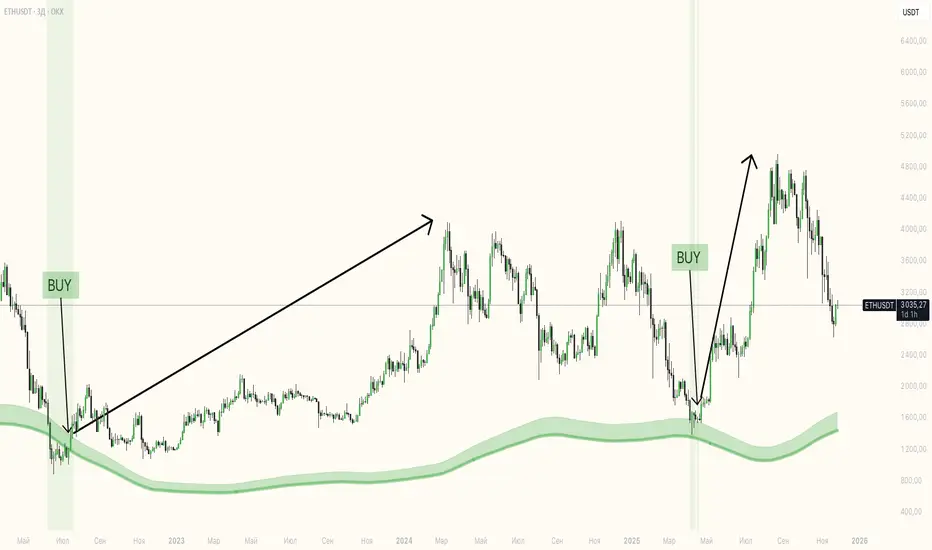
Buy/Sell Signals [WynTrader]Hello dear Friend
Here is a new version ( B-S_251121_wt ) of my Buy/Sell Signals indicator.
Some calculation updates and useful enhancements have been applied.
Concepts
This Buy/Sell Signals indicator generates Buy/Sell signals as accurately as possible, identifying trend changes. Compared to other tools that detect trend shifts, this one is simple, easy to use, and demonstrates its efficiency on its own.
- Its features are carefully designed to minimize false signals while ensuring optimal signal placement.
- The Table results allow you to quickly evaluate signal performance, both on their own and compared to a Buy & Hold strategy.
- The Table calculations are fully synchronized with the visible chart (WYSIWYG – What You See Is What You Get). You can also scroll the chart across different date ranges to see how a stock or product performs under various market conditions.
- Seeing Buy/Sell signals on a chart is appealing, but assessing their performance in a Table makes it even more convincing. And without running a full backtest, you can get a clear overview of overall performance immediately.
Features
This indicator generates Buy/Sell signals using:
- Fast and Slow Moving Averages (adjustable).
- Bollinger Bands (adjustable).
- Filters (optional, adjustable) to refine signals, including : Bollinger Bands Lookback Trend Filter; High-Low vs Candle Range Threshold %; Distance from Fast and Slow MAs Threshold %.
- Results are displayed in a Table on the chart, based on the currently visible start and end dates.
Functionality
- The indicator aims to confirm trend changes through timely Buy/Sell signals.
- It uses two Moving Averages and Bollinger Bands, combined with filters such as BB Lookback, -- The variable settings have been tested with a mix of manual and AI testing to find the optimal configuration. You can adjust the variables to suit your goals.
- The design is simple, with clear parameters and instant readability of Buy/Sell Signals on the chart and in the Table results, without complex interpretation needed.
- It works effectively by requiring both trend confirmation and volatility control management.
- Signals are timed to be as accurate as possible, avoiding futile weak or false ones.
- A Table shows the effectiveness of the signals on the current visible chart, providing immediate, realistic feedback. The Buy & Hold strategy results are also included for comparison with the Buy/Sell swing strategy. The Buy & Hold results start from the first Buy signal to ensure a fair comparison.
- Changing the parameters instantly updates the Table, giving a quick, at-a-glance performance check.
Caution
- No technical tool is perfect; it cannot predict disasters, wars, or the actions of large fund managers or short sellers.
- After testing thousands of TradingView indicators over 24 years, I’ve found none to be 100% accurate all the time.
- This Buy/Sell Signals indicator may outperform some others but is still not perfect.
So, just be aware, and don’t be fooled by this tool.
