ZYTX GKDDThe Zhiying Tianxia High-Sell Low-Buy Indicator Strategy is a trend-following indicator that integrates multiple indicator resonances. It demonstrates the perfect performance of an automated trading robot, truly achieving the high-sell low-buy strategy in trading.
Oscillatori

Umile Indicatore – RSI + Stocastico + EMAs🔍 Overview: Multi-Signal Momentum Indicator
This custom TradingView indicator is a comprehensive technical toolkit combining:
RSI (Relative Strength Index)
Stochastic Oscillator with volume filter
Multi-period EMAs (Exponential Moving Averages)
Customizable visual BUY/SELL signals
It’s designed to detect potential momentum shifts, overbought/oversold conditions, and trend alignment, helping traders identify high-probability entries and exits based on layered confirmations.
🧠 Components Explained
✅ 1. RSI Logic
Detects price momentum and potential reversal zones.
Triggers a BUY signal when RSI crosses above a user-defined oversold level.
Triggers a SELL signal when RSI crosses below an overbought threshold.
You can choose the visual symbol (triangle, circle, or arrow) and set the color for each signal.
✅ 2. Stochastic Oscillator + Volume Filter
Identifies turning points based on the relationship between %K and %D lines.
Signals are only valid if:
A crossover occurs (e.g., %K crosses above %D for a BUY)
Price is in an extreme zone (below oversold or above overbought)
Volume is above its moving average — to filter out weak signals.
Also comes with symbol and color customization.
✅ 3. Exponential Moving Averages (EMAs)
Plots multiple EMAs: 50, 100, 144, 200, 300, 500, 1000.
These help assess trend strength and directional bias.
You can toggle the visibility of EMAs if needed.
✅ 4. Visual & Style Customization
Each signal type (RSI and Stochastic) allows:
Selection of plot shape: triangle, circle, or arrow
Custom BUY/SELL colors
Levels like RSI/Stoch overbought and oversold zones are also plotted for reference.
🎯 How to Use It
Look for confluence between RSI and Stochastic signals to validate entries.
Use EMAs as trend filters — e.g., only take long signals when price is above EMA200.
The volume filter on Stochastic helps reduce false signals in low-activity markets.

Contrarian RSIContrarian RSI Indicator
Pairs nicely with Contrarian 100 MA (optional hide/unhide buy/sell signals)
Description
The Contrarian RSI is a momentum-based technical indicator designed to identify potential reversal points in price action by combining a unique RSI calculation with a predictive range model inspired by the "Contrarian 5 Levels" logic. Unlike traditional RSI, which measures price momentum based solely on price changes, this indicator integrates a smoothed, weighted momentum calculation and predictive price ranges to generate contrarian signals. It is particularly suited for traders looking to capture reversals in trending or range-bound markets.
This indicator is versatile and can be used across various timeframes, though it performs best on higher timeframes (e.g., 1H, 4H, or Daily) due to reduced noise and more reliable signals. Lower timeframes may require additional testing and careful parameter tuning to optimize performance.
How It Works
The Contrarian RSI combines two primary components:
Predictive Ranges (5 Levels Logic): This calculates a smoothed price average that adapts to market volatility using an ATR-based mechanism. It helps identify significant price levels that act as potential support or resistance zones.
Contrarian RSI Calculation: A modified RSI calculation that uses weighted momentum from the predictive ranges to measure buying and selling pressure. The result is smoothed and paired with a user-defined moving average to generate clear signals.
The indicator generates buy (long) and sell (exit) signals based on crossovers and crossunders of user-defined overbought and oversold levels, making it ideal for contrarian trading strategies.
Calculation Overview
Predictive Ranges (5 Levels Logic):
Uses a custom function (pred_ranges) to calculate a dynamic price average (avg) based on the ATR (Average True Range) multiplied by a user-defined factor (mult).
The average adjusts only when the price moves beyond the ATR threshold, ensuring responsiveness to significant price changes while filtering out noise.
This calculation is performed on a user-specified timeframe (tf5Levels) for multi-timeframe analysis.
Contrarian RSI:
Compares consecutive predictive range values to calculate gains (g) and losses (l) over a user-defined period (crsiLength).
Applies a Gaussian weighting function (weight = math.exp(-math.pow(i / crsiLength, 2))) to prioritize recent price movements.
Computes a "wave ratio" (net_momentum / total_energy) to normalize momentum, which is then scaled to a 0–100 range (qrsi = 50 + 50 * wave_ratio).
Smooths the result with a 2-period EMA (qrsi_smoothed) for stability.
Moving Average:
Applies a user-selected moving average (SMA, EMA, WMA, SMMA, or VWMA) with a customizable length (maLength) to the smoothed RSI (qrsi_smoothed) to generate the final indicator value (qrsi_ma).
Signal Generation:
Long Entry: Triggered when qrsi_ma crosses above the oversold level (oversoldLevel, default: 1).
Long Exit: Triggered when qrsi_ma crosses below the overbought level (overboughtLevel, default: 99).
Entry and Exit Rules
Long Entry: Enter a long position when the Contrarian RSI (qrsi_ma) crosses above the oversold level (default: 1). This suggests the asset is potentially oversold and due for a reversal.
Long Exit: Exit the long position when the Contrarian RSI (qrsi_ma) crosses below the overbought level (default: 99), indicating a potential overbought condition and a reversal to the downside.
Customization: Adjust overboughtLevel and oversoldLevel to fine-tune sensitivity. Lower timeframes may benefit from tighter levels (e.g., 20 for oversold, 80 for overbought), while higher timeframes can use extreme levels (e.g., 1 and 99) for stronger reversals.
Timeframe Considerations
Higher Timeframes (Recommended): The indicator is optimized for higher timeframes (e.g., 1H, 4H, Daily) due to its reliance on predictive ranges and smoothed momentum, which perform best with less market noise. These timeframes typically yield more reliable reversal signals.
Lower Timeframes: The indicator can be used on lower timeframes (e.g., 5M, 15M), but signals may be noisier and require additional confirmation (e.g., from price action or other indicators). Extensive backtesting and parameter optimization (e.g., adjusting crsiLength, maLength, or mult) are recommended for lower timeframes.
Inputs
Contrarian RSI Length (crsiLength): Length for RSI momentum calculation (default: 5).
RSI MA Length (maLength): Length of the moving average applied to the RSI (default: 1, effectively no MA).
MA Type (maType): Choose from SMA, EMA, WMA, SMMA, or VWMA (default: SMA).
Overbought Level (overboughtLevel): Upper threshold for exit signals (default: 99).
Oversold Level (oversoldLevel): Lower threshold for entry signals (default: 1).
Plot Signals on Main Chart (plotOnChart): Toggle to display signals on the price chart or the indicator panel (default: false).
Plotted on Lower:
Plotted on Chart:
5 Levels Length (length5Levels): Length for predictive range calculation (default: 200).
Factor (mult): ATR multiplier for predictive ranges (default: 6.0).
5 Levels Timeframe (tf5Levels): Timeframe for predictive range calculation (default: chart timeframe).
Visuals
Contrarian RSI MA: Plotted as a yellow line, representing the smoothed Contrarian RSI with the applied moving average.
Overbought/Oversold Lines: Red line for overbought (default: 99) and green line for oversold (default: 1).
Signals: Blue circles for long entries, white circles for long exits. Signals can be plotted on the main chart (plotOnChart = true) or the indicator panel (plotOnChart = false).
Usage Notes
Use the indicator in conjunction with other tools (e.g., support/resistance, trendlines, or volume) to confirm signals.
Test extensively on your chosen timeframe and asset to optimize parameters like crsiLength, maLength, and mult.
Be cautious with lower timeframes, as false signals may occur due to market noise.
The indicator is designed for contrarian strategies, so it works best in markets with clear reversal patterns.
Disclaimer
This indicator is provided for educational and informational purposes only. Always conduct thorough backtesting and risk management before using any indicator in live trading. The author is not responsible for any financial losses incurred.

Momentum + Heatmap with RSI Cross (Nikko)📘 User Manual: Momentum + Heatmap with RSI Cross (Nikko)
Version: 1.0
Author: Cryptonikkoid
Platform: TradingView – Pine Script v6
License: Mozilla Public License 2.0
Release Date: June 2025
🔍 Overview
The Momentum + Heatmap with RSI Cross is an advanced visual indicator designed to replace traditional oscillators by merging multiple indicators into one. It blends Vortex, Stochastic, RSI, and MACD into a unified, mathematically enhanced momentum signal. This tool highlights trend shifts, potential reversals, and momentum build-up with intuitive visuals and alert signals.
The indicator includes:
A hybrid oscillator reflecting directional strength and momentum.
A heatmap background representing RSI × Vortex energy.
Buy/Sell triangle alerts based on RSI-style crossovers.
A clean layout optimized for decision-making speed.
⚙️ How It Works
Vortex Strength
The indicator computes Vortex Positive (VI+) and Vortex Negative (VI–) over a user-defined period.
The difference between the two creates a directional bias signal (viDiff).
Stochastic Momentum
The viDiff value is normalized through a stochastic oscillator, producing smoothed %K and %D curves.
These curves serve as the base for momentum signals.
RSI and Long-Term RSI
The RSI is computed and normalized to a 0–1 scale.
A long-term RSI (5× period) is also calculated to act as a trend anchor.
MACD Filtering
A MACD calculation determines whether the market is in a bullish or bearish condition.
The hybrid signals are flipped accordingly to follow the broader trend.
Hybrid Oscillator Construction
%K and %D are multiplied by exponential factors of RSI and long RSI.
This adds acceleration to the signals when momentum is increasing rapidly.
RSI Cross Detection
When the hybrid %K crosses above hybrid %D, a Sell triangle appears (potential peak).
When it crosses below, a Buy triangle appears (momentum reversal).
Heatmap Background
A visual background shows the interaction between Vortex and RSI energy.
Colors shift from deep purple (low momentum) to blue (strong bullish energy).
The heatmap can be toggled on/off for clarity.
Alerts
Built-in alert conditions allow you to be notified instantly on buy/sell signals.
🧠 How to Use
Apply the Indicator
Add it to any chart on TradingView.
It works best on trending assets and volatile conditions like crypto or indices.
Read the Hybrid Oscillator
Use the hybrid %K and %D like a momentum wave.
Strong upward waves + a green heatmap = potential long.
Sharp downward spikes + fading heatmap = caution or potential exit.
Watch the Triangles
A green triangle below a bar suggests a buy signal — momentum is reversing upward.
A red triangle above a bar signals momentum exhaustion — potential sell or take profit.
Heatmap Guidance
When the background is faint or fades to purple, it indicates weak conditions.
Blueish tones signal growing bullish strength.
Use with Price Action
Combine triangle alerts with support/resistance, price structure, or volume.
This indicator is not a standalone entry tool, but a strong directional filter.
✅ Benefits
Single Indicator Solution: Replaces multiple tools like MACD, RSI, and Stochastic.
Momentum + Trend Fusion: Combines short-term reversals with long-term trend confirmation.
Visual Simplicity: Clear oscillator waves, triangle icons, and color-coded heatmaps reduce decision fatigue.
Built-in Alerts: Get notified the moment momentum shifts.
Customizable: You can tweak lengths and smoothing for your asset and timeframe.
⚠️ Limitations
Slight Lag: Smoothing adds stability but can delay signals by a few candles.
Whipsaw in Sideways Markets: Like all momentum tools, performance is better in trending conditions.
Requires Confirmation: Best used with other tools like structure or volume to confirm trades.
Experimental Math: This is an experimental formulation; more feedback could help fine-tune signal logic.
🔁 What's New Compared to Traditional Indicators
Unlike using RSI, MACD, or Stochastic separately, this indicator:
Integrates all three into a unified momentum model.
Adds long-term RSI filtering to reduce noise.
Uses exponential scaling to enhance signal acceleration.
Features heatmap visualization to intuitively show energy buildup.
Provides actionable visual alerts without relying solely on numeric values.
🛠️ Tips and Customization
Adjust the rsiLength, viLength, and MACD settings for different markets (e.g. faster for scalping, slower for swing).
Toggle off the heatmap if you prefer a cleaner look using the checkbox.
Use higher timeframes (4h, 1D) for swing trading or lower timeframes (15m–1h) for intraday.
Combine with volume spikes or trendlines to enhance trade confirmation.
Add alertcondition() messages to trigger webhook or mobile alerts.
🎯 Final Thoughts
Momentum + Heatmap with RSI Cross simplifies the complexity of momentum analysis into a smooth, visually intuitive signal. It helps identify entry zones early, avoid chasing reversals blindly, and gives clear exit alerts based on dynamic crossovers.
If you want cleaner charts with smarter momentum tracking — this tool is built for that.

RSI Mansfield +An adaptive relative strength indicator for any market and timeframe.
OVERVIEW
This indicator plots the Mansfield Relative Strength (RSI Mansfield) oscillator, a tool to compare the performance of your instrument against a chosen benchmark index or asset. It auto-adjusts to cryptocurrencies, stocks, and various timeframes, applying the appropriate smoothing techniques to reveal true relative strength or weakness.
CONCEPTS
Relative Strength: Measures how the price of your asset evolves compared to a benchmark (e.g., BTC dominance, S&P 500).
Mansfield Normalization: Expresses the deviation from the moving average of the ratio between your asset and the benchmark, scaled to highlight trends.
Adaptive Smoothing: Automatically selects EMA or SMA smoothing depending on market type and timeframe.
Divergences: Detects regular and hidden bullish or bearish divergences in the Mansfield oscillator, which can signal potential reversals.
FEATURES
Supports major global stock indices and crypto benchmarks.
Auto-selection of moving average length (daily, weekly, monthly).
Dynamic coloring: green for positive relative strength, red for negative.
Configurable detection of four divergence types:
Regular Bullish Divergence
Hidden Bullish Divergence
Regular Bearish Divergence
Hidden Bearish Divergence
Toggle switch to show/hide divergences.
Clear zero baseline reference.
USAGE
Benchmark Selection
Choose the benchmark index or asset you want to compare against, e.g., Bitcoin Dominance, S&P 500, or other regional indices.
Interpret Colors
Green oscillator: outperforming the benchmark.
Red oscillator: underperforming.
Analyze Divergences
Enable divergence detection to spot potential reversal points. Regular divergences indicate classical divergence; hidden divergences may confirm continuation.
Timeframes
Works on intraday, daily, weekly, or monthly charts. The indicator auto-adjusts smoothing and calculation length accordingly.

PRO Investing - Apex Engine FREE VERSION🧠 The Apex Engine: True Self-Tuning Intelligence
The biggest flaw in most indicators is that they rely on fixed settings. The Apex Engine solves this with two layers of adaptation:
Fully Auto-Adjustable Parameters: The engine first analyzes the volatility of the asset on your chart to derive its own optimal "Fast," "Mid," and "Slow" momentum lengths. You never have to guess settings again—it tunes itself for any instrument and timeframe.
Performance-Based Selection: It then uses statistical correlation to constantly measure which of its auto-tuned parameters is most in-sync with recent price action. It deploys the "winning" engine to generate signals, ensuring you're always using the most relevant analysis.
🎨 An All-in-One, Unified View
We've engineered this script to deliver maximum information with minimum clutter, all within a single indicator.
High-Confluence Buy/Sell Signals (▲/▼): Clear triangles appear directly on your chart. These are not simple crossovers; a signal is only plotted if it aligns with the dominant trend (above/below the 200MA) and the market is not choppy (ADX > 20).
Compact Oscillator Display: A "lite" version of the oscillator is displayed in a compact panel at the bottom of your price chart, showing the active Velocity line and its signal.
Transparent Dashboard: A small table in the corner shows you the engine's "brain" at work, displaying the real-time correlation scores and highlighting the active parameter.
Smart Background Coloring: The entire chart background changes color to give you immediate context:
🟩 Green: Bullish trend, favorable conditions for buys.
🟥 Red: Bearish trend, favorable conditions for sells.
⬛ Gray: Caution zone. Market is choppy or counter-trend.
This tool is designed to be the ultimate all-in-one solution for traders who value automation, clarity, and adaptive analysis.
If you find this indicator powerful, please leave a Boost 👍 and Follow our Profile for more professional-grade tools.
Disclaimer: All indicators are for analytical and educational purposes only. Trading involves significant risk. Always use your own judgment and risk management.

Z-scored ZLEMA | OquantZ-Scored ZLEMA | Oquant
This indicator combines the Zero-Lag Exponential Moving Average (ZLEMA) with Z-score normalization to present recent ZLEMA values relative to its mean. It helps users observe trend direction and momentum with reduced lag, while also highlighting potential overbought or oversold levels based on how far ZLEMA values deviate from their mean.
🧠 Concept Overview
📉 Zero Lag Exponential Moving Average (ZLEMA)
The EMA is a popular tool that calculates an average price, but unlike a simple moving average, it gives more weight to recent prices. This means the EMA reacts faster to new price changes and is less affected by older data. However, even with this weighting, the EMA still introduces some lag.
ZLEMA improves on the EMA by reducing this lag. It does this by adjusting how it accounts for previous prices, effectively "shifting" the data to better align the average with current market action. The result is an average that stays smooth but responds more quickly to real price changes—helping traders spot turning points or trend shifts earlier without being fooled by random noise.
📏 Z-score Normalization
Once ZLEMA is calculated, the indicator applies Z-score normalization to measure how far the current ZLEMA value is from its mean. The Z-score expresses this difference using standard deviations, providing a clear, standardized scale. This helps highlight when price moves are unusually strong—either upward or downward—beyond normal fluctuations.
🔍 How This Indicator Works
Smooth Price Data with ZLEMA
The indicator begins by applying the Zero-Lag Exponential Moving Average (ZLEMA) to the chosen price data. Unlike a regular moving average, ZLEMA reduces the typical delay by adjusting the input data before averaging. It does this by "shifting" the price series to remove the lag caused by older prices. This way, ZLEMA stays smooth but reacts more quickly to recent price changes—helping the indicator follow market moves faster without being too noisy.
Normalize ZLEMA values Using Z-score
Once ZLEMA is calculated, the indicator applies Z-score normalization to measure how far the current ZLEMA value is from its mean. The Z-score expresses this difference in terms of standard deviations, creating a clear, standardized scale. This helps highlight when price moves are unusually strong—either up or down—beyond normal fluctuations.
Set Signal Thresholds
Two threshold levels are set on the Z-score scale—crossing above the upper threshold is considered a long (buy) signal, indicating bullish momentum, while crossing below the lower threshold is considered a short (sell) signal, indicating bearish momentum.
Show Visual Signals on the Chart
The Z-score and bars are plotted with colors: green when Z-score is above the bullish threshold, purple when Z-score is below the bearish threshold.
⚙️ Customizable Inputs
Source: Choose the price source (close, open, etc.) for calculations.
ZLEMA Length: Adjust the ZLEMA length to control smoothness versus responsiveness.
Z-score period: Set the Z-score period to define how far back the indicator measures normal price behavior.
Thresholds: Adjust the upper and lower thresholds to control how sensitive the indicator is to strong momentum changes.
📈 Practical Use
This indicator helps identify trend directions and changes faster by combining ZLEMA with statistical analysis. It highlights when price moves are stronger than normal, making it easier to spot early signs of momentum shifts. Traders can use it to confirm trends or detect potential reversals with more timely signals.
🔔 Alert Support
This indicator includes optional built-in alert conditions that notify you when the Z-score crosses above the bullish threshold (long signal) or below the bearish threshold (short signal). You can enable these alerts to get timely updates on potential momentum shifts without constantly watching the chart.
⚠️ Disclaimer: This indicator is intended for educational and informational purposes only. Trading/investing involves risk, and past performance does not guarantee future results. Always test and evaluate indicators/strategies before applying them in live markets. Use at your own risk.

OG SuperTrend + RSI Option + Enhanced ORB v2 © 2025This elite-level indicator combines the precision of SuperTrend and RSI signals with a mathematically accurate Opening Range Breakout (ORB) system and Previous Day High/Low zones, providing traders with real-time directional bias and sniper-level entry guidance.
🔍 Core Features:
✅ SuperTrend + RSI Buy/Sell Signals
✅ Real-time RSI Tracker (Top Right)
✅ Clean visual BUY/SELL labels on trend shifts
✅ Mathematically accurate 5-Min & 10-Min ORB Levels
✅ Live tracking of Previous Day High/Low Zones
✅ Clean chart layout with elite color-coded precision
✅ Instant alert conditions for both bullish and bearish setups
🔔 Recommended Use:
Combine with price action, candlestick patterns, and volume spikes
Ideal for options flow, intraday scalping, and breakout strategies
Works beautifully on 1m, 5m, 15m, and 1H timeframes
📊 Settings Include:
Adjustable ATR Period & SuperTrend Multiplier
Toggle Buy/Sell Labels
Customizable RSI Length

TRADING GURU LIVE FLASHHi guys,
If you are looking to add some watermark into your charts. You can use this indicator.
You can add add a title and a subtitle, if you want to write in diferents lines, you can use as you can see in the script.
This is just a watermark, which follows my personal style an aesthetic when it comes to Pinescript tools. I like to keep my charts clean to focus on Time and price, and I love to have a reminder to remain disciplined.
Homo Faber Fortunae Suae is a Latin maxim which loosely translates to: Humans Are The Makers Of Their Own Destiny.
So make your own destiny, master yourself and the charts!
All the features are customizable: position, text size, text color, background.
Enjoy it.

Relative Strength IndexRelative Strength Index (mikolajan)
This is a modified built-in Relative Strength Index (RSI) indicator with two lines added to it to add an internal range.

RFM Strategy - High QualityI trade high-probability resistance fades using a systematic 4-pillar approach that has delivered a proven 60%+ win rate with 2.5+ profit factor."
📊 Core Strategy Elements:
1. VRF Resistance Identification:
Multiple resistance level confluence (minimum 2 levels)
Dynamic resistance zones using 20-period high/low ranges
Only trade when price approaches clustered resistance
2. Volume Weakness Confirmation:
Volume ROC must be ≤ -30% (weak buying pressure)
Identifies exhaustion rallies with poor participation
Confirms institutional selling vs retail buying
3. Momentum Divergence:
SMI ≥ 60 (extreme overbought) OR 25-point momentum collapse
Multi-timeframe confirmation for higher reliability
Catches momentum exhaustion at key levels
4. Price Rejection Patterns:
Long upper wicks (2x body size) at resistance
Doji formations showing indecision
Failed breakout patterns with immediate rejection
⚡ Execution:
Entry: Only when ALL 4 conditions align simultaneously
Risk Management: 6-point stops, 12-point targets (2:1 R/R minimum)
Timeframe: 5-minute charts for precise entries
Selectivity: Quality over quantity - average 5 trades per period
🏆 Performance:
60% win rate (matches manual trading performance)
2.59 Profit Factor (highly profitable)
Systematic approach eliminates emotional decisions
"This strategy automates the discretionary resistance fade setups that institutional traders use, with strict filters ensuring only the highest-probability opportunities."

Metaplanet MSW Strike LevelsMetaplanet Moving Strike Warrant (MSW) Price Tracker
This indicator displays Metaplanet's actual Moving Strike Warrant pricing schedule with real-time strike price visualization. It shows the exact strike prices that determine warrant exercise values based on Metaplanet's official MSW terms.
Key Features:
Current Period: Strike locked at ¥1,649 from June 24th through July 1st, 2025
Automatic Updates: Starting July 2nd, strike prices re-evaluate every 3 trading days using 3-day SMA of closing prices
Visual Strike Lines: Yellow horizontal lines show active MSW strike prices for each period
Background Signals: Light green when price is above strike (favorable), light red when below
Information Panel: Orange table displays current strike price and next evaluation date
Evaluation Markers: Orange/yellow dots mark re-evaluation dates
How It Works:
The indicator follows Metaplanet's official MSW schedule, automatically calculating new strike prices every 3 trading days based on the 3-day simple moving average of previous closing prices. This helps warrant holders track exercise opportunities and understand the dynamic pricing mechanism.

ZYTX RSI SuperTrendZYTX RSI SuperTrend
ZYTX RSI + SuperTrend Strategy
The definitive integration of RSI and SuperTrend trend-following indicators, delivering exemplary performance in automated trading bots.

ZYTX CCI SuperTrendZhiYing CCI + SuperTrend Strategy
The definitive integration of CCI and SuperTrend trend-following indicators, delivering exemplary performance in automated trading bots.

EMA/ATR/RSIThis indicator overlays three key technical measures—Exponential Moving Average (EMA), Average True Range (ATR), and a custom-scaled Relative Strength Index (RSI)—on your price chart, all using the same lookback period.
Features
• EMA (Exponential Moving Average): Smooths price action to highlight trend direction.
• ATR (Average True Range): Measures market volatility via an RMA-smoothed True Range.
• RSI (Modified): Scales the standard RSI by subtracting 35 and multiplying by 2, shifting the baseline for clearer momentum signals.
Inputs
• period (integer): Lookback length for EMA, ATR, and RSI calculations (default: 14).
How to Use
1. Adjust period to suit your preferred timeframe (e.g., 14 for daily charts, 7 for intraday).
2. Use the EMA line to identify trend direction and dynamic support/resistance.
3. Monitor ATR to gauge changing volatility—wider bands signal stronger moves.
4. Watch the modified RSI crossovers around zero:
• Above 0: Bullish momentum
• Below 0: Bearish momentum
Combine these three overlays to refine entries, exits, and stop-loss placement based on trend strength, volatility, and momentum all in one view.

SMA/EMA Cross SignalFor short-term swing traders (such as I am) this is a simple indicator that plots 2 moving average lines of your choice, the SMA and EMA to the screen and has built in buy/sell signal when they cross.
I personally use this when price action is above the 50 SMA. The default setting (5SMA/10EMA) is what I use and has been working for me as long price action is above the 50 SMA.
Features:
1) Alerts are triggered when SMA (Signal line) and the EMA (Baseline) cross - a Long signal is called if the cross is above the EMA, a exit if the cross is below EMA
2) Signals are represented visually on the chart, below the candles is a long, above is a short.
Good luck!

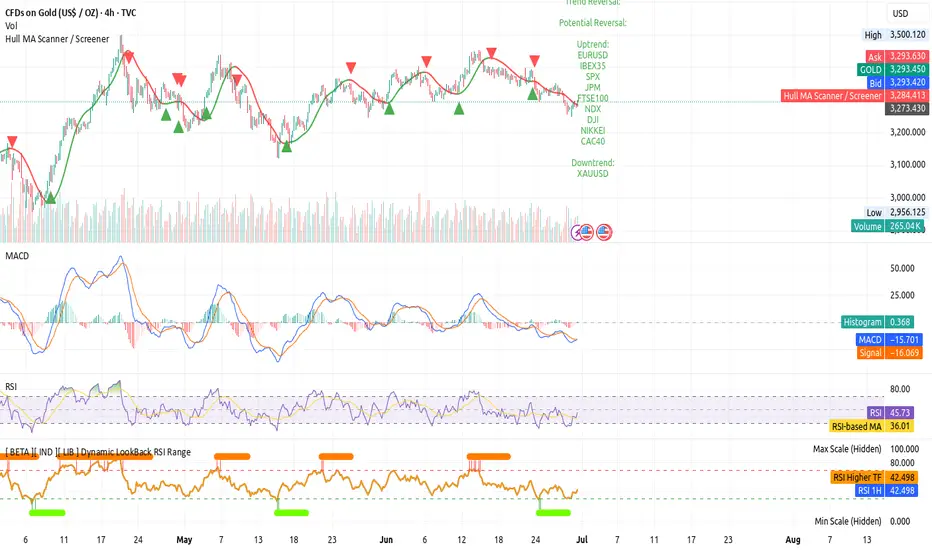
[ BETA ][ IND ][ LIB ] Dynamic LookBack RSI RangeGet visual confirmation with this indicator if the current range selected had been oversold or overbough in the latest n bars
📈 Smart Alert System — EMA/MA/Volume/SMC AlertsHere's a detailed description of your custom TradingView **Pine Script v6**:
---
### 📌 **Title**: Smart Alert System — Webhook Ready (with EMA, MA, Volume, and SMC)
This script is designed to **monitor price behavior**, detect important **technical analysis events**, and **send real-time alerts via webhook to a Telegram bot**.
---
## 🔧 SETTINGS
| Setting | Description |
| ----------------------- | ------------------------------------------------------------------------------ |
| `volumeSpikeMultiplier` | Multiplier to determine a volume spike compared to the 20-bar average volume |
| `testAlert` | If `true`, sends a test alert when the indicator is first applied to the chart |
---
## 🔍 COMPONENT BREAKDOWN
### 1. **EMA & MA Calculations**
These indicators are calculated and plotted on the chart:
* **EMAs**: 13, 25, 30, 200 — used for trend and touch detection
* **MAs**: 100, 300 — used for break and retest detection
```pinescript
ema_13 = ta.ema(close, 13)
ema_200 = ta.ema(close, 200)
ma_100 = ta.sma(close, 100)
```
---
### 2. **📈 Volume Spike Detection**
* A volume spike is identified when the current bar's volume is **2x (default)** greater than the 20-period average.
* A red triangle is plotted above such candles.
* A **JSON alert** is triggered.
```pinescript
volSpike = volume > avgVol * volumeSpikeMultiplier
```
---
### 3. **📊 EMA Touch Alerts**
* The script checks if the current close is:
* Within 0.1% of an EMA value **OR**
* Has crossed above/below it.
* If so, it sends an alert with the EMA name.
```pinescript
touch(val, crossed) =>
math.abs(close - val) / val < 0.001 or crossed
```
---
### 4. **📉 MA Break and Retest Alerts**
* A **break** is when price falls **below** a moving average.
* A **retest** is when price climbs **above** the same average after breaking below.
```pinescript
breakBelow(ma) => close > ma and close < ma
```
---
### 5. 🧠 **SMC Alerts (Break of Structure \ & Change of Character \ )**
These follow **Smart Money Concepts (SMC)**. The script identifies:
* **BOS**: New higher high in uptrend or lower low in downtrend
* **CHOCH**: Opposite of trend, e.g. lower low in uptrend or higher high in downtrend
```pinescript
bos = (high > high ) and (low > low ) and (low > low )
choch = (low < low ) and (high < high ) and (high < high )
```
---
### 6. 🧪 Dummy Test Alert (1-time fire)
* Sends a `"✅ Test Alert Fired"` to verify setup
* Executes **once only** after adding the indicator
```pinescript
var bool sentTest = false
if testAlert and not sentTest
```
---
### 7. 🚀 Alert Delivery (Webhook JSON)
All alerts are sent as a JSON payload that looks like this:
```json
{
"pair": "BTCUSD",
"event": "🔺 Volume Spike",
"timeframe": "15",
"timestamp": "2024-06-29T12:00:00Z",
"volume": "654000"
}
```
This format makes it compatible with your **Telegram webhook server**.
---
### 🔔 Alerts You Can Create in TradingView
* Set **Webhook URL** to your `https://xxxx.ngrok-free.app/tradingview-webhook`
* Use alert condition: `"Any alert()`" — because all logic is internal.
* Select **"Webhook URL"** and leave the message body blank.
---
### 🛠️ Use Cases
* Notify yourself on **EMA interaction**
* Detect **trend shifts or retests**
* Spot **volume-based market interest**
* Get real-time **BOS/CHOCH alerts** for Smart Money strategies
* Alert through **Telegram using your Node.js webhook server**
---
Would you like me to break down the full Pine Script block-by-block as well?

TRADING GURU - WatermarkHi guys,
If you are looking to add some watermark into your charts. You can use this indicator.
You can add add a title and a subtitle, if you want to write in diferents lines, you can use as you can see in the script.
All the features are customizable: position, text size, text color, background.
Enjoy it.

🔁 EMA 3/21 Crossover Strategy — Exit on Opposite SignalEMA 3/21 Crossover Strategy — Exit on Opposite Signal
This strategy enters trades based on a crossover between two exponential moving averages:
Buy Entry: When the 3-period EMA crosses above the 21-period EMA
Sell Entry: When the 3-period EMA crosses below the 21-period EMA
Exit Rule: Positions are exited only when an opposite signal occurs (i.e., a new crossover in the other direction)
Key Features:
Designed for trend-following setups
Uses ATR-based SL/TP lines for visual reference only (trades do not auto-close at SL/TP)
Suitable for manual or automated trading logic with high trade clarity
Can be applied on any timeframe and any liquid instrument (Forex, crypto, indices, etc.)
Recommended Use:
Combine with volume or session filters for improved signal quality
Ideal for traders seeking clear entry/exit rules with minimal noise
Best on trending instruments and medium timeframes (USDJPY; Daily)

ZYTX SuperTrend V1ZYTX SuperTrend V1 Indicator
Multi-strategy intelligent rebalancing with >95% win rate
Enables 24/7 automated trading
